That might not last. AI systems have been improving at math so rapidly that it’s unclear what role, if any, human mathematicians will play a decade from now.
Paul Erdős was one of the most prolific mathematicians in history. He wrote over 1,500 papers in his lifetime, the most ever. One of his greatest talents was coming up with problems that are simple to state but have deep roots.
In 1946, he introduced the unit distance problem. Imagine you have some points in a 2D plane and you measure the distance between each pair of points:
Credit:
Kai Williams / Understanding AI
Credit:
Kai Williams / Understanding AI
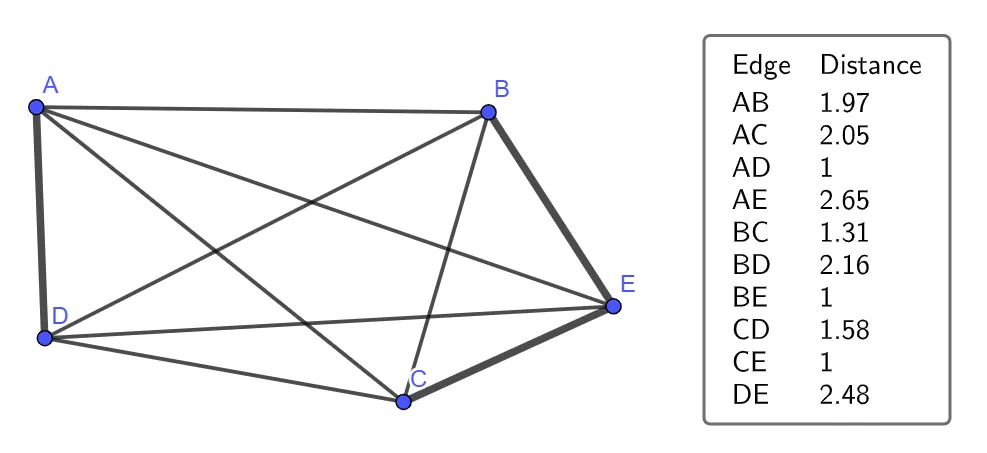
In this diagram, there are five points and ten pairs of points. Three pairs happen to be exactly 1 unit apart: AD, BE, and CE.
Can we rearrange the points so that more pairs of points are exactly 1 unit apart?
Yes. For instance, we could move points A and D to be closer to the B, C, and E cluster. With a bit more work, we could further rearrange the points so that there are seven pairs exactly one unit apart. But that’s the most we can do.
We could do the same analysis with 6 points, 7 points, and so on. But as the number of points grows, the problem very quickly becomes too complicated to find the exact answer.
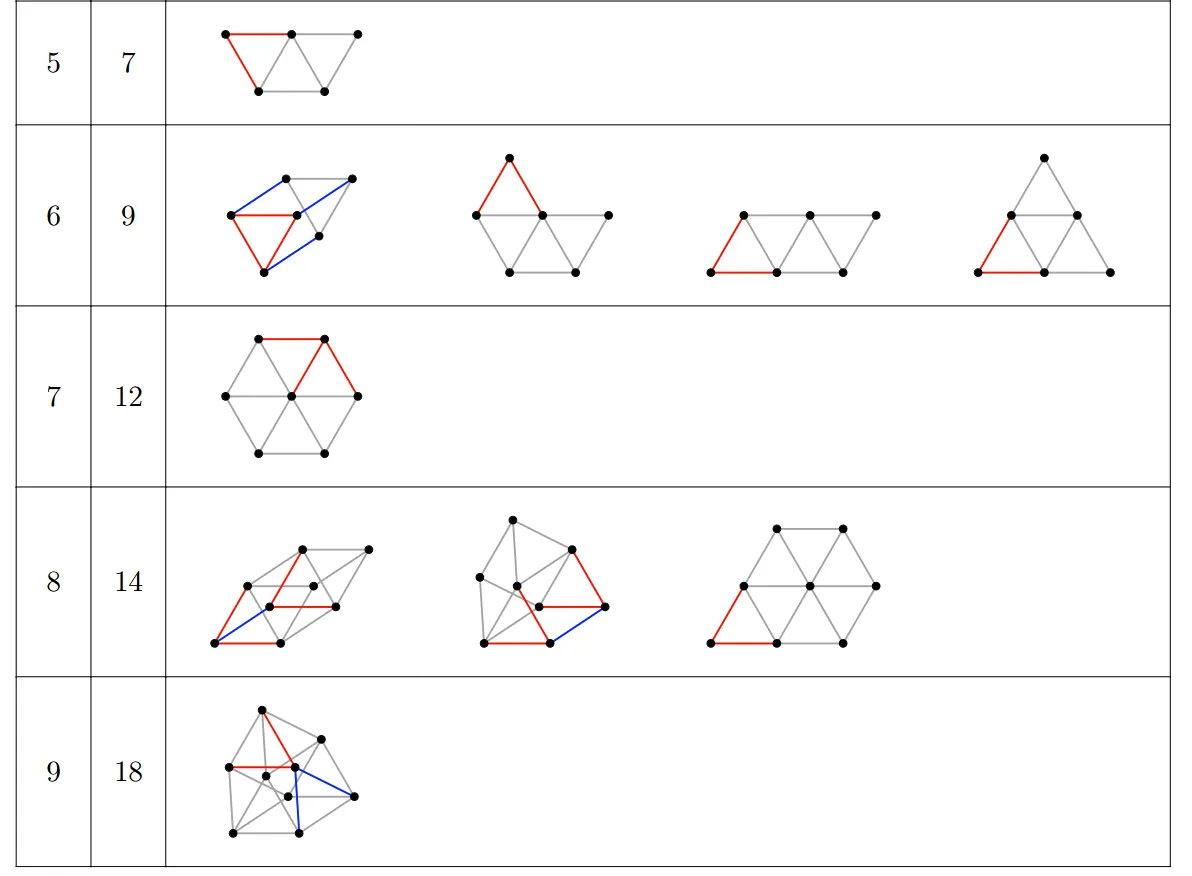
The arrangements of 5, 6, 7, 8, and 9 points that have the most pairs of points exactly one unit apart. Figure from the appendix of “The Erdős unit distance problem for small point sets” by Boris Alexeev, Dustin G. Mixon, and Hans Parshall showing the optimal arrangements for 5 through 9 points. Alexeev et al. give the optimal solutions through 21 points; the question is open after that.
The arrangements of 5, 6, 7, 8, and 9 points that have the most pairs of points exactly one unit apart. Figure from the appendix of “The Erdős unit distance problem for small point sets” by Boris Alexeev, Dustin G. Mixon, and Hans Parshall showing the optimal arrangements for 5 through 9 points. Alexeev et al. give the optimal solutions through 21 points; the question is open after that.
Credit: Boris Alexeev et al.So instead of asking exactly how many unit distances are possible for a given number of points, Erdős tried to calculate upper and lower bounds on the number of length-one lines for n points, assuming that n is a large number.
To help calculate a lower bound, Erdős assumed that the points would be laid out in a grid. This is probably not the optimal layout, but if he could demonstrate that points in a grid have a certain number of pairs with unit distance, then the optimal arrangement must have at least that number.