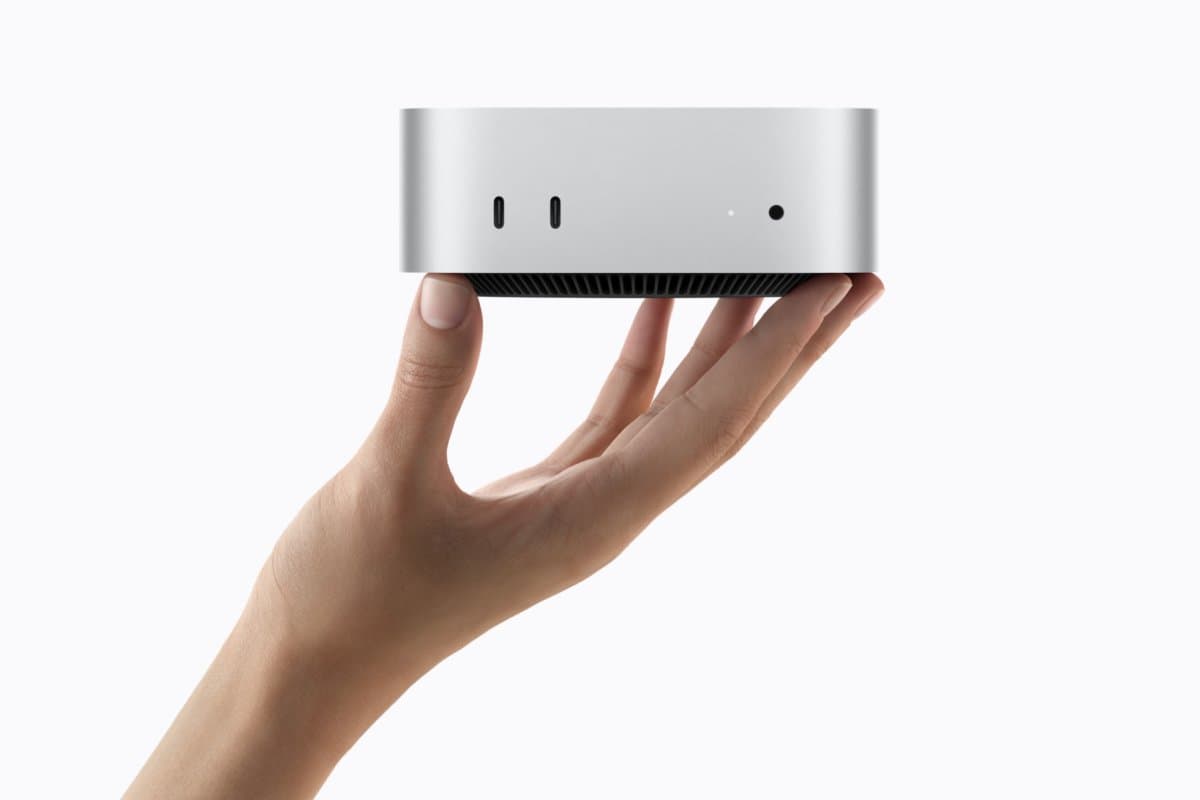
Apple announced two new processors on Tuesday, which power its new Mac Mini and Mac Studio models: the M5 Ultra and M6 chips.
The M5 Ultra, which Apple deems its “most powerful chip ever,” fuses two dual-die M5 Max chips to form Apple’s first quad-die chip, designed to manage hefty AI workloads. The chip includes an up-to-36 core CPU and up-to-80 core GPU and 1.2 TB/s of unified memory bandwidth, which is 50% more than the M3 Ultra, which Apple released only about a year and a half ago.
While the M5 Ultra is designed for professionals doing compute-intensive work like complex 3D rendering, visual effects, and running frontier AI models, the Mac Studio with M5 Ultra will no doubt appeal to hobbyist AI developers as well. But Apple’s M6 chip is more geared toward these everyday users, according to the company.
“Built using the cutting-edge 2 nm process, M6 combines a new CPU complex, two additional CPU and GPU cores, a Dual 16-core Neural Engine, and more unified memory bandwidth to power through workloads with amazing energy efficiency,” Apple vice president of Silicon Engineering Sri Santhanam said in a press release.
With the M6’s 12-core CPU complex, which adds two more cores than the M5, the M6 chip can offer nearly a 30 percent increase in peak GPU compute for AI compared to the M5, which improves the speed of prompt processing when using on-device LLMs.
“With these frameworks and new chips, developers can run and fine-tune large AI models locally on their Mac,” Apple wrote in a press release. “Apple’s developer tools and frameworks automatically optimize performance across the CPU, GPU, and Neural Engine, and give developers the ability to use Apple Foundation Models, App Intents to tap into Apple Intelligence features, or their own proprietary AI models to build and run powerful AI workloads entirely on device.”
Apple trailed behind its competitors when it comes to building its own proprietary AI model — the long-awaited Siri upgrade is powered by Google’s Gemini. But Apple has excelled in using on-device technology to allow users to more securely take advantage of tools like Face ID and Touch ID, which would be a privacy nightmare if processed via the Cloud. Similarly, Apple’s emphasis on powering on-device AI workloads could be where the company has a chance to shine, offering a more secure, controlled environment for developers to experiment with new AI tools.
Apple’s newest Mac Mini devices are available for pre-order now, starting at $899. They will ship after September 22.