References included in iOS 27 beta 5 point to a new feature designed to authenticate the camera source of an iPhone photo. Here are the details.
Apple working on new Reference Image feature
While the challenge posed by synthetic images trying to pass as authentic is not new, it has become an increasingly pressing issue with the rise of generative AI imagery.
What used to take a skilled photo editor hours, or even days, can now be accomplished in seconds, with little more than a short prompt based on a half-formed idea.
To address this, several companies have already introduced ways to make AI-generated content easier to identify. Google, for instance, developed SynthID, which embeds imperceptible watermarks into AI-generated images and other media. The technology has since expanded beyond Google’s own products, with companies including OpenAI adopting it for generated images.
Likewise, Meta has introduced labels for AI-generated content across Facebook, Instagram, and Threads, though such systems have faced limitations in reliably identifying manipulated media, even when created by the company’s own AI models.
Now, it appears that Apple might be gearing up to tackle the problem as well, in addition to “marking up” the metadata of images created via Image Playground. New code in iOS 27 beta 5 shows that the company is working on something called Apple Reference Image, which is designed to authenticate the source of photos using unique data tied to the iPhone camera hardware that captured them.
In line with Apple’s privacy-focused approach to cloud-based processing of potentially sensitive user data, the company is designing Apple Reference Image in a way that prevents Apple from accessing the raw photo itself.
Instead, the system sends the image to Private Cloud Compute for authentication, while only certain sensor information and photo metadata are sent back to Apple. Interestingly, if Apple determines that a sensor may have been compromised, it may revoke prior authentications associated with that sensor.
As it stands, the feature is off by default, and once it’s live, it will be turned on via Settings > Camera > Reference Image, and tapping Reference Mode.
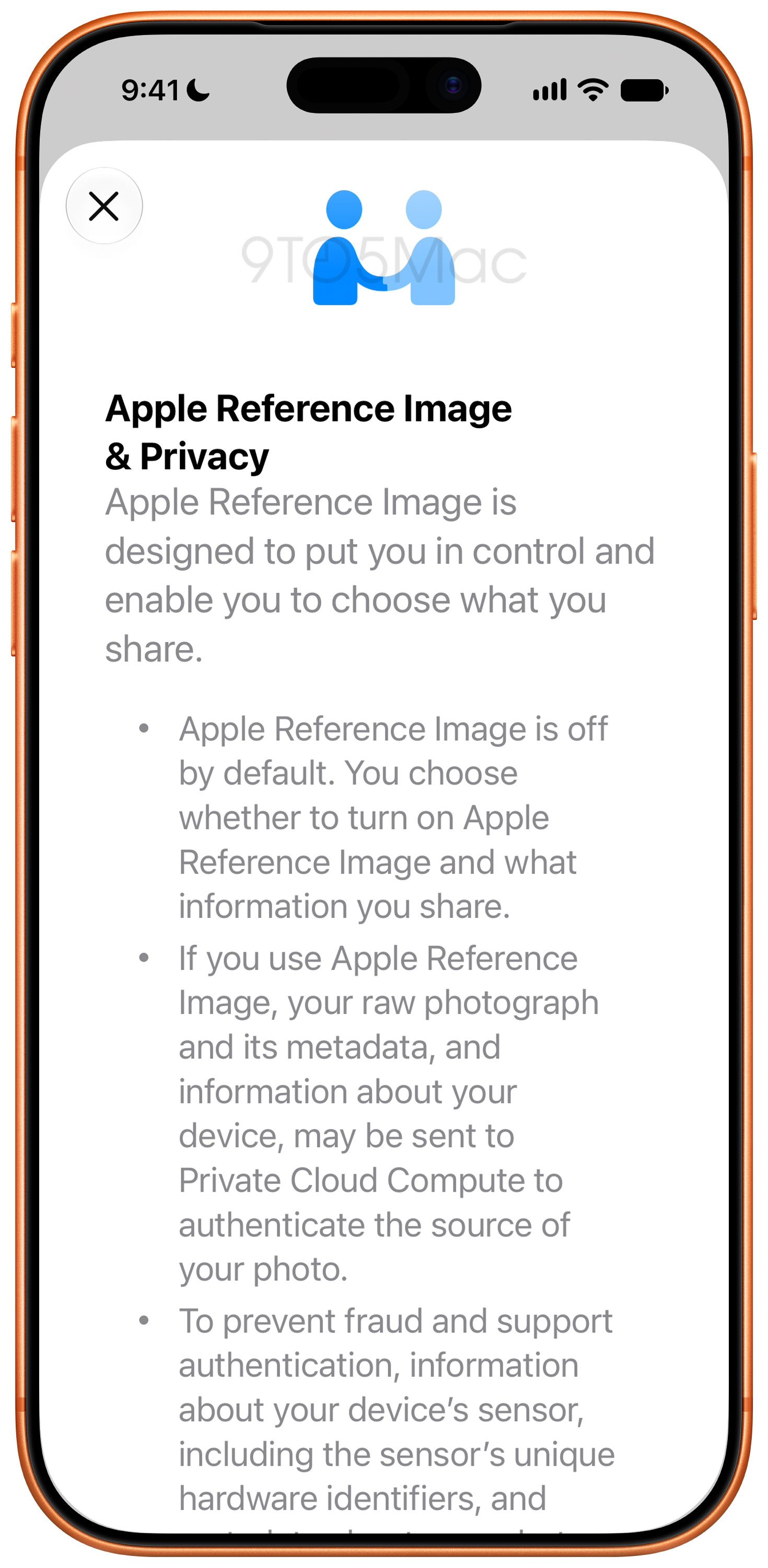
Importantly, Reference mode must be used when capturing the photo via a new “Reference” mode in Camera. This means that photos taken normally won’t contain the provenance information needed to be authenticated later.
Reference mode itself does not appear to authenticate the photo automatically. Instead, users can later choose to authenticate it, at which point the raw image and associated provenance data are sent to Private Cloud Compute for verification. During authentication, Apple assigns the photo a unique ID.
Another privacy-focused aspect of the system is that authenticated photos can also be shared with others, whose Apple devices can check locally whether the photo remains authenticated, without telling Apple which images they are viewing.
The information included when sharing may vary depending on the method used (AirDrop, Messages, etc.) and whether the photo is an original, edited, or authenticated version. Notably, if the user chooses to share “All Photos Data,” Apple says the transfer may also include unique hardware identifiers and any uncropped footage associated with the image.
Apple is also adding a “Transfer with Provenance” option for USB transfers. When enabled, authenticated photos transferred to a Mac or PC will include their Reference Image data, while unauthenticated photos may still carry provenance information such as unique hardware identifiers and any uncropped footage.
What’s your take on Apple Reference Image? Let us know in the comments.
Worth checking out on Amazon
FTC: We use income earning auto affiliate links. More.