The Apple Watch is reigning king among fitness trackers, but there's a big enough gap in the market for Apple to release a ring-style tracker, even though it probably won't.
I hate the Apple Watch. I know, I know, heresy, but I do.
And I don't even hate it for a singular reason. I hate it for a multitude of reasons, which is impressive, because I've bought three in my lifetime.
I hate the way the Apple Watch looks. It's too chunky on my delicate little bird-wrists and, regardless of the band I choose, it managed to ruin every non-gym outfit I ever wore it with.
It's also physically uncomfortable as all get out. I'm not entirely sure how everyone else here manages to wear theirs at the desk.

I'm sorry, but this just doesn't look cool.
I'm a bit more flexible than I should be, so as a result, I needed to wear my watch "upside down" to avoid summoning Siri every time I ride my bike, do a push-up, or push open a door. It also pinches the ever-loving crap out of my inner wrist, eventually leading to a bruise that horrifies everyone who's ever seen it.
I'm willing to bet that some of this may be my faulty genetics. Sure, it's not Apple's fault, but it's still something I have to live with.
But the worst part about the Apple Watch? It is, effectively, another screen vying for my attention.
I didn't know this until I bought my first Apple Watch and wore it for a month, but attaching a screen directly to my body is not ideal. I am not built for a screen I can't opt out of.
I don't think I'm alone in this, either. Even with going in and manually disabling all but the barebones notifications, it doesn't seem to be enough.
It always goes something like this:
There's a buzz when my phone rings or I get a text. I look at the screen, despite the fact that I've already reached for my phone or looked at my desktop screen. Now I'm interfacing with my Apple Watch. I'm touching the screen for some reason, now I'm scrolling through the information there.
I'm holding my iPhone, sitting in front of my iMac, and looking at my Apple Watch. I'm suddenly a caricature of a tech-addicted millennial in a political comic.
If this sounds extreme, don't worry, it is. But this is also just how I react to the constant reminder that I'm available to everyone and every app in my life at all times. I am not built for this sort of thing.
So, into the box, and onto the electronic bay, my Apple Watch went. Goodbye, psychological torture device.
I already hear you guys typing your comments, saying, "Well, then don't wear an Apple Watch. And, for the love of all things holy, stop buying them!"
And yes, I agree! Except there's one problem:
I actually like the Apple Watch.
In theory.
Hello, midlife crisis.
Before we get started here, I'd like to point out that I am not an athlete. For years, I'd argue that I was actually the opposite of an athlete in pretty much every way you could be.
However, in 2023, I got my first bike after not having one since 2005. Suddenly, I was doing things like "going outside," "going to the gym," and "willingly participating in physical activity instead of aimlessly walking around my city in an effort to stave off the inevitable decay of my corporeal form."
All that to say, I wasn't completely sedentary before 2023, but I definitely wasn't prioritizing physical activity.
Three years later, I now hit the gym four or five times a week, weather permitting. Also, weather permitting, I'll log about a hundred miles on my bike in the same timeframe.
This year I've started hiking. I've managed to hike about 20 miles, which is impressive solely because of the hostile weather the Great Lakes region has had to endure this year.

I enjoy going hiking on one of the rare days that the weather allows it.
I'm pretty proud of how much I've changed in the last three years. I don't actually think this is a midlife crisis, for the record, I think I just got a bike and could do more things.
That being said, I've done a lot in the last three years, and I like seeing how I can improve. Currently, my method for tracking that improvement is a bunch of different apps and relying on the basic features of my iPhone.
If only there were a way to track this data in a single device. And could you imagine if it were integrated with Apple's ecosystem nicely?
Oh, wait. There is.
And I sold it on eBay. Twice, actually.
Damn it.
Understanding the follies of fitness trackers
Fitness tracking is, as many health professionals will tell you, not an exact science. Fitness trackers themselves aren't infallible, and they're far less accurate than the manufacturers would lead you to believe.
There are scenarios in which fitness trackers are not actually useful. Caloric burn, or more accurately, energy expenditure, is probably the most well-known place where fitness trackers come up short.
If you got an Apple Watch to hit a target amount of calories burned in a day, I've got some bad news for you: it doesn't actually have any idea how many calories you've burned.
Most studies say the Apple Watch is accurate within an 18% to 40% range. You know what else is probably accurate within a 40% range?
Me. I can probably guess how many calories I've burned going on a one-hour-long hike at a moderate pace, and I'd probably be within 40% of the actual number.
A lot of this is purely human biology. A fitness tracker can make an educated guess, but it is effectively a form of digital divination, reading tea leaves and spitting out something fact-adjacent.
Step tracking is another thing that is difficult for a tracker to measure. A "step" is not a standardized unit of measurement or a standardized movement across all bodies.
It's wild that we assume a fitness tracker could accurately guess the steps of both shuffling elderly and elite college athletes. Steps taken in crowded areas will be measured differently from those done on uneven ground while jogging on a wilderness scale.
The Apple Watch is markedly better at tracking steps than energy expenditure. According to an Ole Miss meta study, the Apple Watch is within a 10% of the actual number of steps taken, at least in a lab setting.
So if they're not useful for tracking activity, why would we want to use them? Or, more specifically, why do I want one?
Getting trendy with it
While fitness trackers might not track things perfectly, they are actually quite good at tracking things over time. For the average person, and even for most lower-level athletes, you don't actually need hard numbers to track your progress.
What you need is trends over time.
For example, let's say your Apple Watch move goal is 350 calories. If you're hitting that consistently, it doesn't actually matter what the number of calories burned was.
Eventually, that goal may increase, either because you increased it or the Apple Watch decided it needed to be higher. If you continue to meet or exceed that goal, you've got documentation that you're trending in a positive direction.
Same with exercise minutes. Maybe you started with a modest goal of 10 minutes a day, but over time you began stretching that to 12, then 15, then 20.
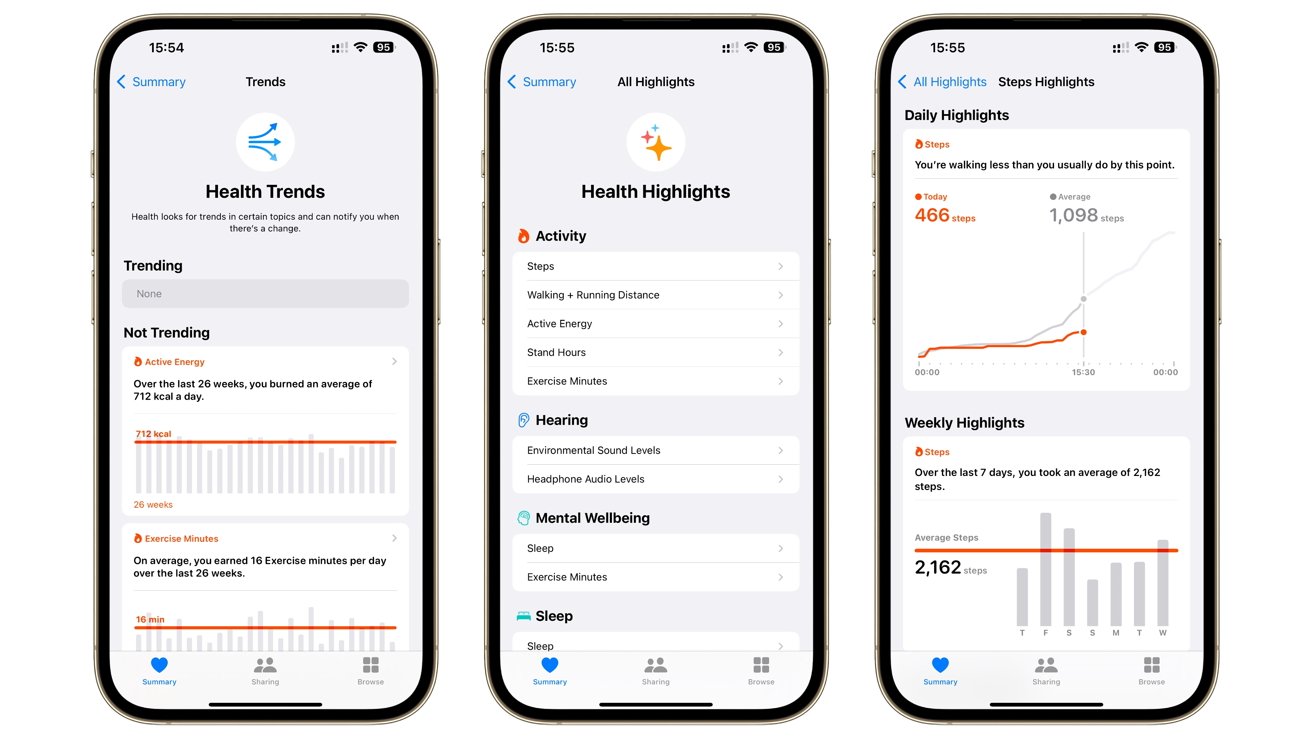
Views of Trends and Highlights in Health for iOS
Similarly, you can also use downward trends to keep an eye on your health. Maybe you notice you start taking fewer steps, suggesting you're not getting enough movement in.
Maybe your VO2 starts dropping steadily below your baseline in the days before you become ill. This is genuinely beneficial information to have.
And the only way you can track those trends is by consistently wearing a fitness tracker.
Bringing it full circle
I know a lot of people love the Apple Watch, and they're great at wearing it consistently. And I'm super happy for them.
I'm not one of those people. And judging by the fact that Oura's done well enough for itself to release the fifth iteration of its tracking ring, there's a solid market for non-wrist-based trackers.
And once upon a time, Apple was rumored to be working on such a device. Though if you've been around the block a couple of times, you know that patents effectively mean nothing in terms of what will or won't make it to market.
I would love an Apple Ring were one to ever actually materialize, provided Apple didn't decide that it needed to be another "everything" device like the Apple Watch.
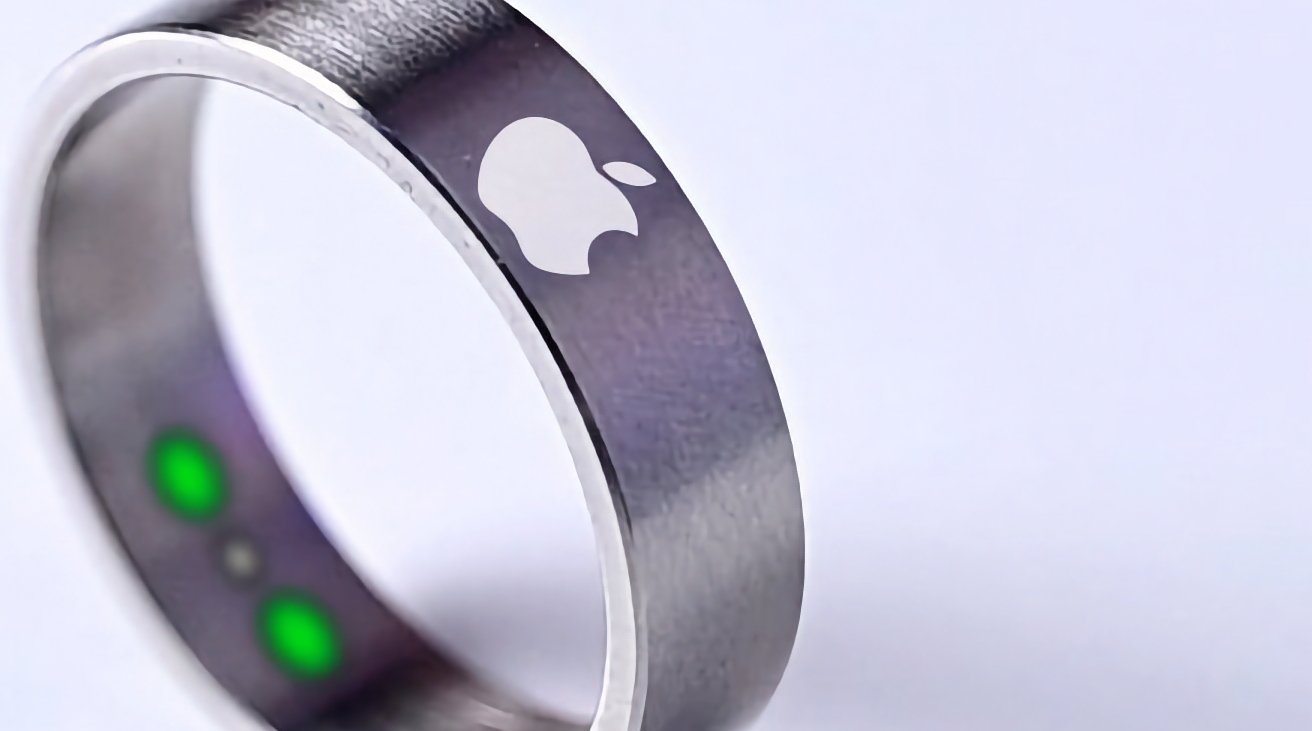
Render of a possible Apple Ring
I would wear the ring every day. I want my sleep metrics, I want to know my heart rate during an intense biking session. I'd like to know what it thinks my average step counts are, so I can work on getting that number higher.
Wearing a ring is pretty set-and-forget as far as activities go. I used to wear my second-generation Oura ring all the time before the battery life finally started degrading to the point of needing to be charged daily.
For the record, I appreciate what Oura is doing, but I still crave the deep Apple ecosystem integration. I want to close my rings, I just want to do it sans Apple Watch.
I really want this stupid ring to exist. Which, frankly, sucks, because I don't think it's going to happen anytime soon.
I think Apple's figured out exactly where it wants to be vis-a-vis the whole device roadmap for the next five years.
We just got the MacBook Neo, and the iPhone Fold is coming out at some point. I suspect that Apple's HomePod-with-a-Screen will make an appearance at some point in the next year or two.
Apple's going to buckle down and come to market with some sort of AR glasses situation, much to my chagrin.
I think if Apple made a fitness ring, it would entirely upset the wearable market again. I think it would sell, and I think it would sell incredibly well.
I could see it doing better than AirPods, frankly.
And maybe that's another reason Apple won't do it. Apple wants you to buy an Apple Watch.
The Apple Watch comes with accessories you can swap out, and third-party developers make and, crucially, sell, apps for it. You only have to produce an Apple Watch in a few different sizes, whereas an Apple Ring would probably need to come in at least eight sizes.
And the Apple Ring would most assuredly cut into the Apple Watch market. Considering how hard Apple pushes the Apple Watch, I can't see it wanting to split people off for what it may view internally as a less worthwhile product.
So, I don't see it happening anytime soon.
For now, I suppose I'll continue to use my four separate apps to track the various workouts I do. Maybe someone else will come to market with a ring that is just as good as the Apple Ring could be.
Maybe I'll eventually cave and buy an Oura Ring 5.
Either way, I'm still going to hope Apple has a change of heart and finds a way to make the fitness tracker of my dreams a reality. I think it'd be way better than the stupid Pixar lamp it's allegedly got in the works, at any rate.