Stone tools from two sites in China seem to be older than Homo erectus. At Shangchen, a site on the southern edge of China’s Loess Plateau, archaeologists unearthed stone tools from a 2.1-million-year-old layer of sediment. And at the Xihoudu site in northern China, stone tools date to 2.43 million years ago. So either Homo erectus is older than we thought, or some other hominin species got there first. If that’s the case, then an even older member of our genus, like Homo habilis or Homo rudolfensis—species that anthropologists previously surmised weren’t adaptable enough to gain footholds in so many different parts of the world—may be the real ancestor of the Hobbits.
Veatch and her colleagues’ study, along with several previous studies of Homo floresiensis‘ anatomy and behavior, may lend some support to that idea.

This comparison shows Homo floresiensis alongside the skulls of two of its potential ancestors, plus Homo naledi.
This comparison shows Homo floresiensis alongside the skulls of two of its potential ancestors, plus Homo naledi.
“Evidence for behavioral complexity in Homo floresiensis, including complex tool and fire use, have weakened considerably over time,” wrote Veatch and her colleagues. “The evidence to date suggests that Homo floresiensis did not engage in a behavioral repertoire as diverse or as flexible as in modern humans or Neanderthals, possibly due to an ancestry in which large game hunting and controlled use of fire did not evolve.”
In other words, hominins descended from Homo erectus should have at least the same skills and cognitive abilities, which would include things like using fire and, potentially, organized hunting parties. Without those abilities, it’s easier to see Homo floresiensis as potentially descended from some earlier, less brainy species—still tool-users, but not fire-using big-game hunters—like Homo habilis or Homo rudolfensis.
Of course, we still don’t know the answer, and the evidence is complicated.
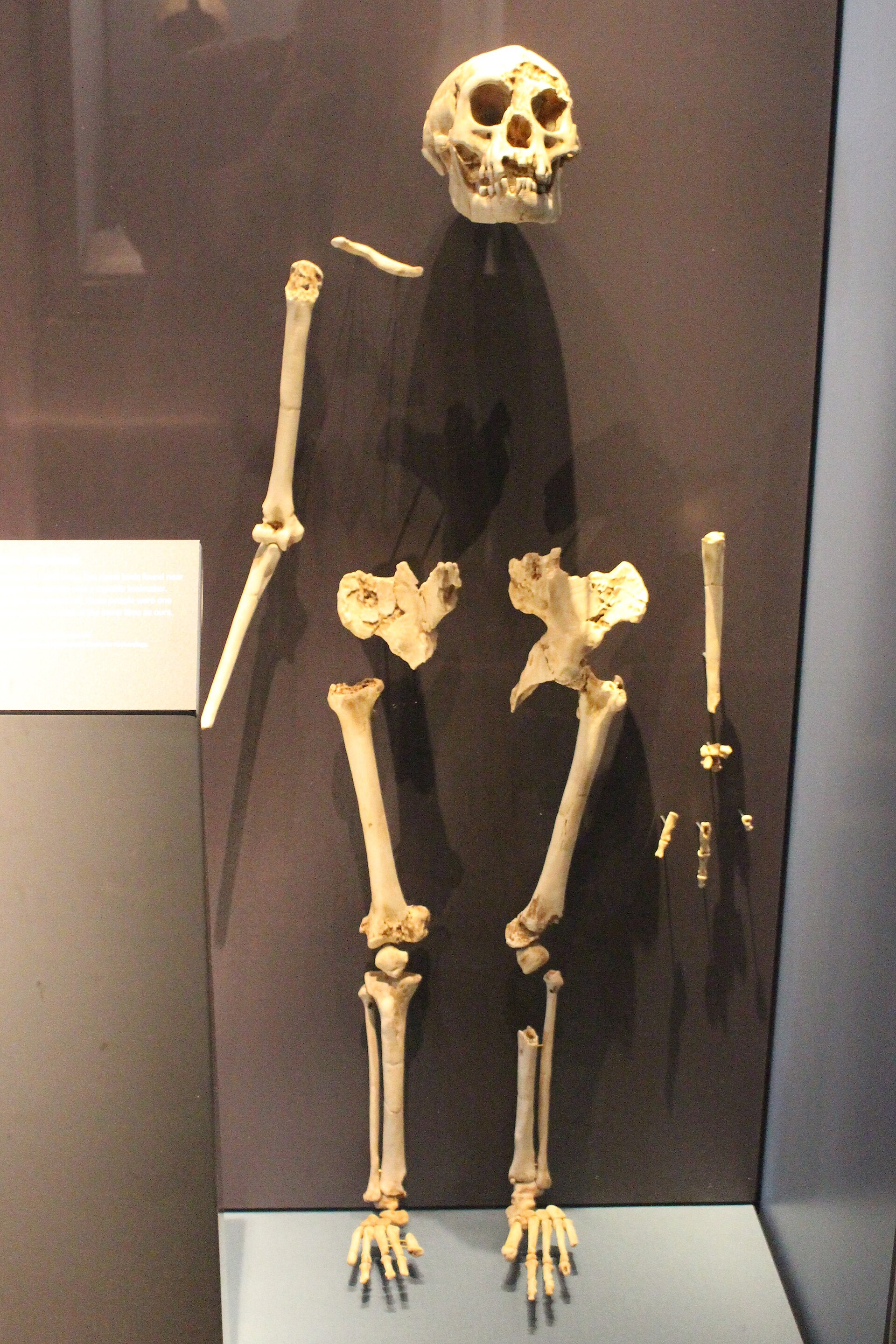
The skeleton of a female
Homo floresiensisin the Natural History Museum in London.
Credit:
Emőke Dénes, CC BY-SA 4.0
The skeleton of a female Homo floresiensis in the Natural History Museum in London. Credit: Emőke Dénes, CC BY-SA 4.0 <https://creativecommons.org/licenses/by-sa/4.0>, via Wikimedia Commons
Evidence is clear; interpretation is tricky
Veatch and her colleagues’ recent study isn’t the first to challenge the idea that Homo floresiensis hunted big game and used fire, or that they descended from Homo erectus. Some of Homo floresiensis’ features, like the shapes of bones in its feet and the angle of its upper arms, suggest that it may be more closely related to Australopiths like Lucy than to Homo erectus.