Everyone else uses the alternative LMDh approach, which requires the entrant to start with a carbon fiber chassis (or spine) from one of four approved race car manufacturers; in this case, Ford chose ORECA as the supplier. Each OEM also must use the same spec gearbox, electric hybrid motor, and hybrid battery, but they supply their own engine and software and design the bodywork. This is the approach used by Alpine, BMW, Cadillac, Genesis, and Porsche. McLaren and Ford will join them next year.
Overall levels of downforce, as well as the ratio of downforce to drag, are capped in both LMH and LMDh, and all the cars are subjected to the “balance of performance” process that levels the playing field.
Like Cadillac, Ford has opted for a naturally aspirated V8 to power its Hypercar. In this case, it’s a 5.4 L V8 that’s derived from the “Coyote” V8 you’ll find in some Mustangs. The company could have simply used the same 5.4L Coyote that lives under the hood of Ford’s Mustang GT3 race car, but Ford Racing’s chief powertrain engineer, Christian Hertrich, told Road and Track earlier this year, “As we got into it, the speeds at which we need to push, the expectations, and really just competition level drove us into a lot of unique architecture and components.”
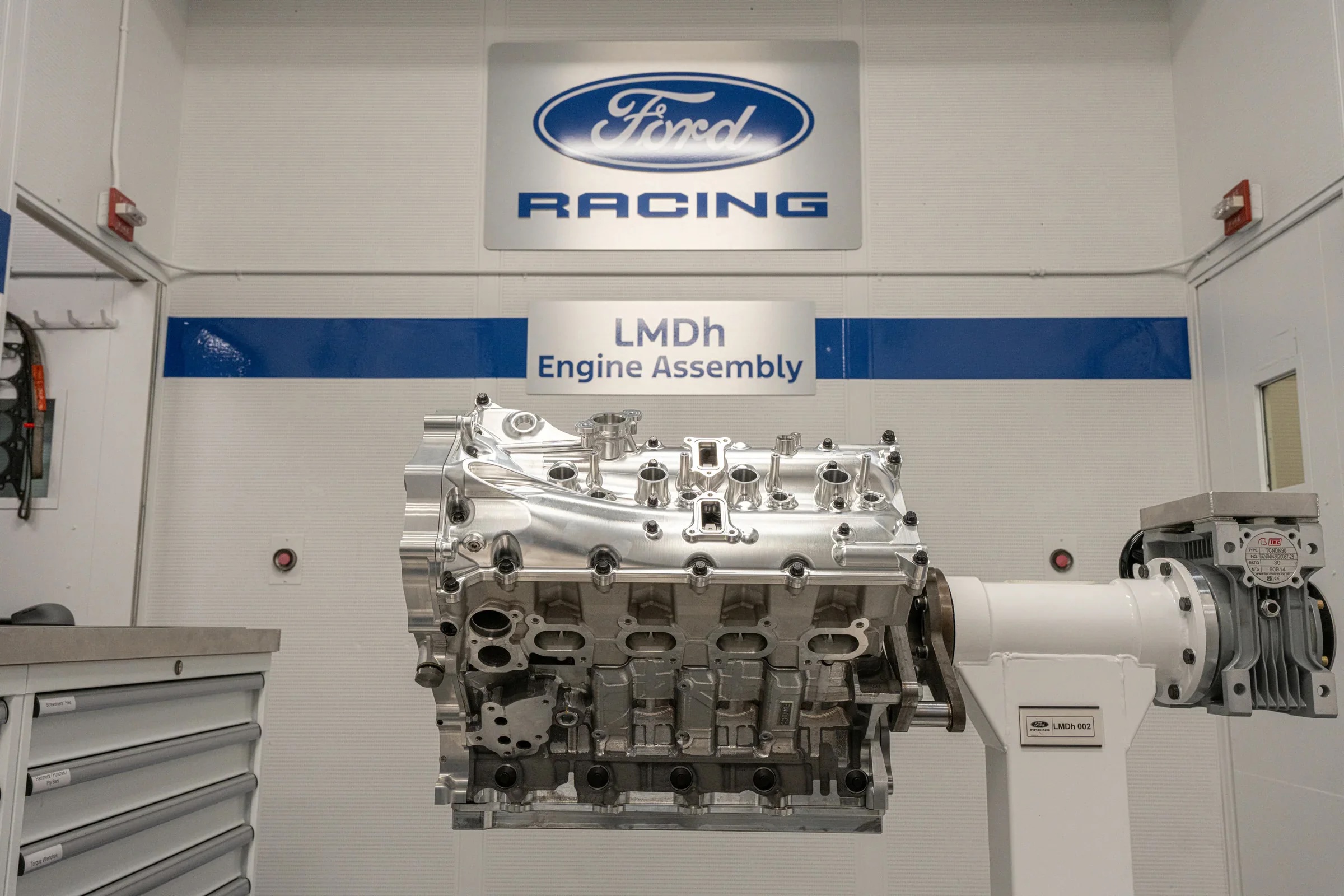
The Ford Hypercar V8, or at least some of it.
Credit: Ford
The Ford Hypercar V8, or at least some of it. Credit: Ford
Ford hasn’t released any video from the Paul Ricard test yet, but it did post a dyno test to YouTube for those curious about what this V8 sounds like.
The Ford Hypercar actually started initial shakedown testing on August 5 with Campbell, Mike Rockenfeller, and Tom Blomqvist. Ford says the testing “proceeded smoothly and according to plan.” Having verified that all the various control systems on this complicated hybrid race car were functional, it started the test program on Monday with Campbell (a multiple winner in Porsche’s 963 Hypercar) and the ex-F1 Sergeant, with Blomqvist set to join them in the next few days.