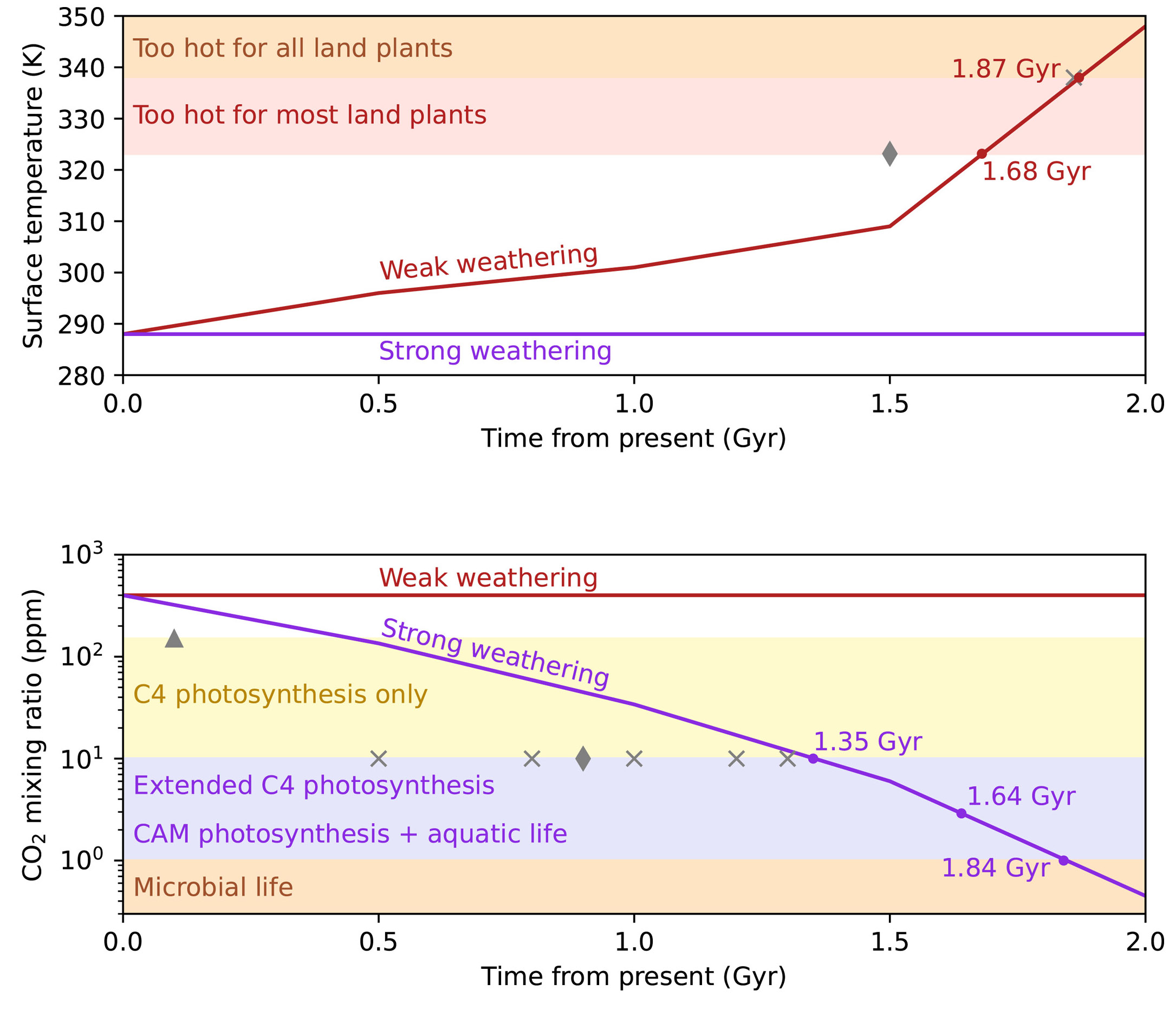
Model timelines for the weak and strong weathering scenarios. Temperature in the top plot is in kelvins—a change of 1 kelvin is equivalent to 1 °C. Carbon dioxide in the bottom plot is on a logarithmic scale. (10
1is 10 parts per million, 10
2is 100 parts per million, etc.)
Model timelines for the weak and strong weathering scenarios. Temperature in the top plot is in kelvins—a change of 1 kelvin is equivalent to 1 °C. Carbon dioxide in the bottom plot is on a logarithmic scale. (10
1is 10 parts per million, 10
2is 100 parts per million, etc.)
Credit: Haqq-Misra and Wolf/JGR AtmospheresThat’s optimistic?
The, uh, good news about these estimates for the demise of complex life on Earth is that they’re actually a bit more optimistic than most previous studies. That’s down to the 3D model producing a little less warming for a brighter Sun, the expectation that CO2 declines more slowly over time, and a slight expansion of the CO2 range believed to be survivable by plants. Many previous estimates had put life’s expiration date at less than 1 billion years from now.
Obviously, there are a bunch of additional considerations that could significantly alter this story, and the researchers mention a few. If civilization persists long enough to see some of these changes, geoengineering would certainly be an option—like spreading aerosols in the stratosphere to reflect sunlight, for example.
There are even some wilder suggestions out there, like moving Earth’s orbit farther from the Sun or removing some of the Sun’s mass to tame the red giant. (We have a billion years to work on the logistics, after all.)
Less speculatively, evolution could have a say in the physiological limits of Earth’s plants. Any adaptations that expand the range of survivability would extend the timeline.
Ultimately, the point of modeling this kind of thing is not to make a confident prediction. Apart from the simple natural curiosity about what will happen to our world, this is also relevant to wondering about the potential for life on other worlds. The window of time during which life on Earth is possible tells us something about where to look outside our Solar System.
Land plants have been present on Earth for almost 500 million years, and if this new estimate is right, they could stick around for almost 1.9 billion more. As was the case for a few billion years early on, microbial life might again have the place to themselves for a while after that.
JGR Atmospheres, 2026. DOI: 10.1029/2025JD045586 (About DOIs).