Google Pixel 11 Pro Fold review: Doing more but not quite enough
Google's latest foldable sports some welcome upgrades, but its lack of a major design change is disappointing.
Google Pixel 11 Pro Fold review: Doing more but not quite enough
Google’s latest foldable sports some welcome upgrades, but its lack of a major design change is disappointing.
RATING : 8.5 / 10
- New main camera sensor
- Updated Pixel software
- Slimmer bezels and 10 percent lighter than before
- Much faster 25-watt wireless charging
- Design still feels chunky
- Smaller battery than last year
- HiLight doesn’t do enough (yet)
- No 120x Pro Res Zoom like on the other Pixel 11 Pros
The original Pixel Fold borrowed some of the best elements from the Surface Duo and added class-leading cameras and a more refined design. Then its successor the Pixel 9 Pro Fold switched things up again by shifting to a taller chassis with what at the time was the largest main display of any foldable phone on sale. However, last year's Pixel 10 Pro Fold was a much more iterative update, and Google has taken the same approach with its new Pixel 11 family.
This puts the Pixel 11 Pro Fold in a tough spot. Priced at $1,899 (which is $100 more than before), even though Google's latest foldable is 10 percent lighter while also sporting updated software, a new main camera and faster charging, it's facing tougher competition than ever. So while long-time Pixel fans can look to this handset as a continuation of what Google does best combined with a big foldable screen, its rivals are shining just a bit brighter than the latest folding Pixel.
Design and displays: Lighter but still very tanky
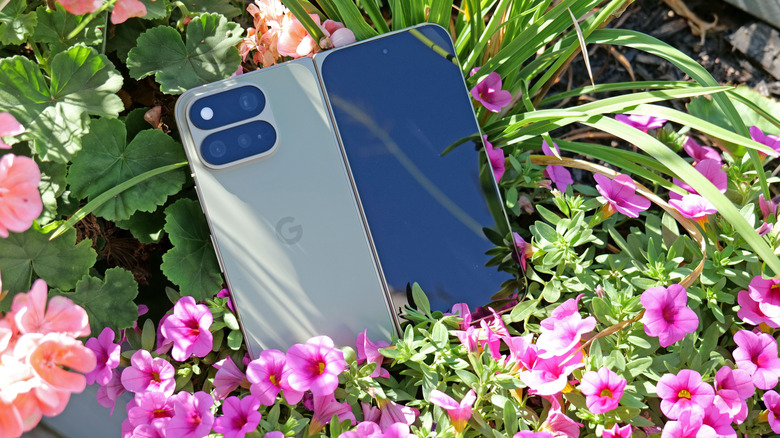
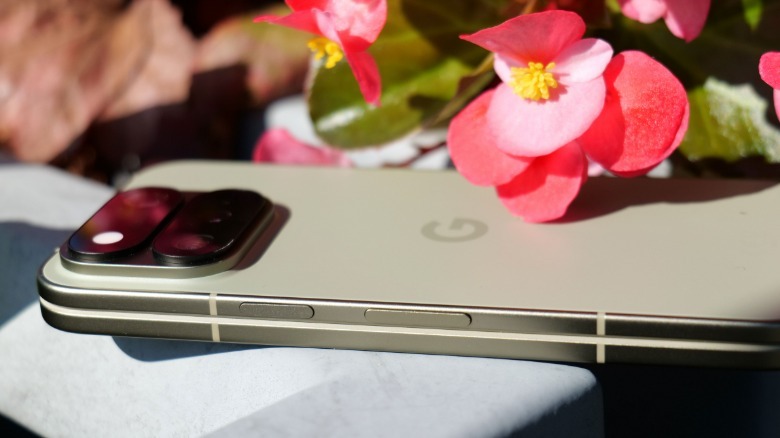
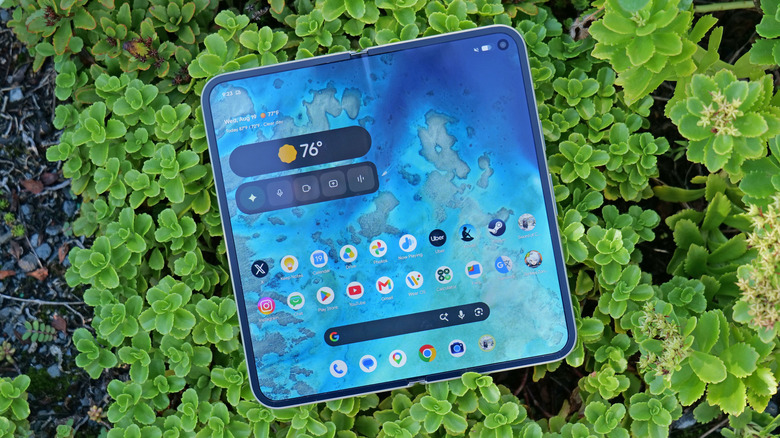
Aside from a handful of fresh color options, the Pixel 11 Pro Fold looks and feels almost exactly the same as last year's phone. That said, I do enjoy the olive model, as its pale gold frame really compliments the handset's matte green back. Furthermore, that rear panel is now made out of a glass fiber material that Google claims is "nearly impossible to crack," though I hope you'll forgive me for not throwing this thing down a flight of stairs to confirm.
I also suspect the switch to that new composite back helped Google reduce the P11PF's weight (238 grams), as the phone is 10 percent lighter than its predecessor (258 grams). Unfortunately, despite thinner bezels, the Pro Fold (10.1mm thick when closed) still feels significantly bulkier than both the base Galaxy Z Fold 8 (201 grams and 9.7mm) and the Z Fold 8 Ultra (215 grams and 8.9mm). Even the Motorola Razr Fold — which sports similar dimensions (243 grams and 10.1mm) along with a slightly larger main display — feels a bit sleeker due its more tapered sides. Plus, both Samsungs and the Razr are easier to open too.
 Sam Rutherford for Engadget
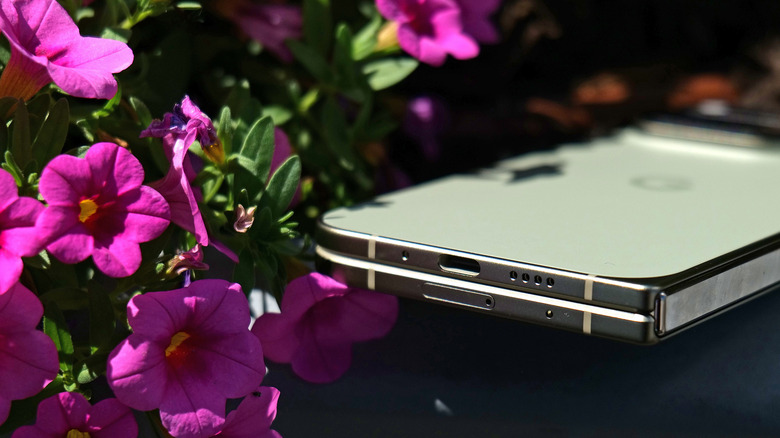
Elsewhere, you get familiar features like a side-mounted fingerprint reader built into its power button, a USB-C port on bottom and a big triple cam module around back. Google has also retained native support for magnetic accessories, so unlike with the Z Fold 8 line, you don't need a case to attach things like wireless chargers or stands. Finally, I should note that while the rest of the Pixel 11 family (at least in the US) is eSIM-only, the Pro Fold still has a physical SIM tray.
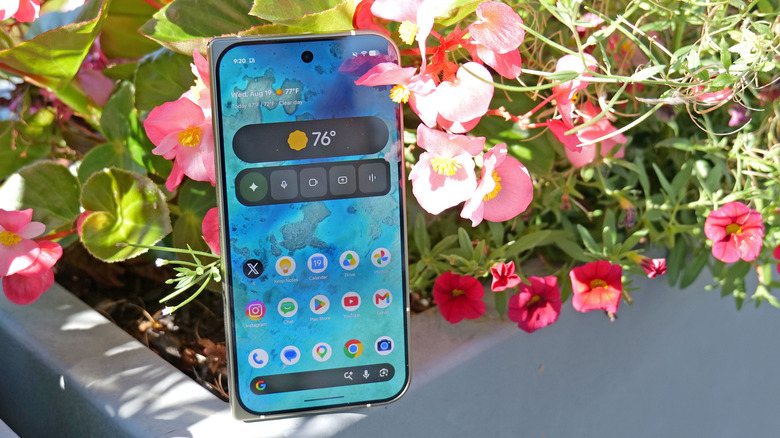
As for its displays, not a ton has changed here either, but that's OK, because both the 6.5-inch exterior and 8-inch interior OLED displays are rich and colorful. Peak brightness has increased a touch from 3,000 to 3,600 nits, allowing for even better outdoor visibility. And between a new ceramic cover glass for its outside screen and the same class-leading IP68 rating we got on the previous model, what the Pixel 11 Pro Fold lacks in slenderness is offset by top-notch durability.
HiLight: A work in progress
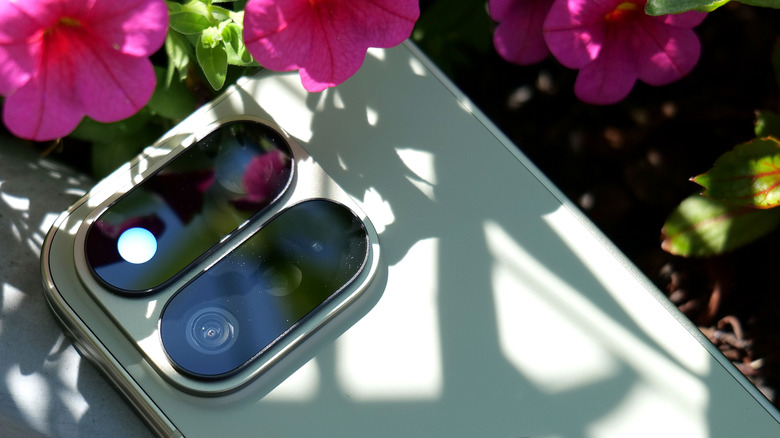
By adding a new set of LEDs inside the Pixel 11 Pro Fold's rear flash module, Google created a subtle way to keep people informed even when the phone is face down on a table. The issue is that I feel like this feature is a victim of the company's seemingly single-minded focus on AI, because the only things HiLight can do is turn on when you trigger Gemini or get a call from one of your designated contacts. Google says it's looking into adding support for texts and messages, but at least at launch, that won't be available. I also wish I could use HiLight to show battery status or when specific apps send out notifications, neither of which seem all that difficult to implement. Instead, we got the ability for the LED to change colors when you talk to AI, which isn't even in my top 10 most desired functions. But then again, I don't spend a ton of time having deep heart to hearts with Gemini, so your mileage may vary.
Performance: Steady improvements
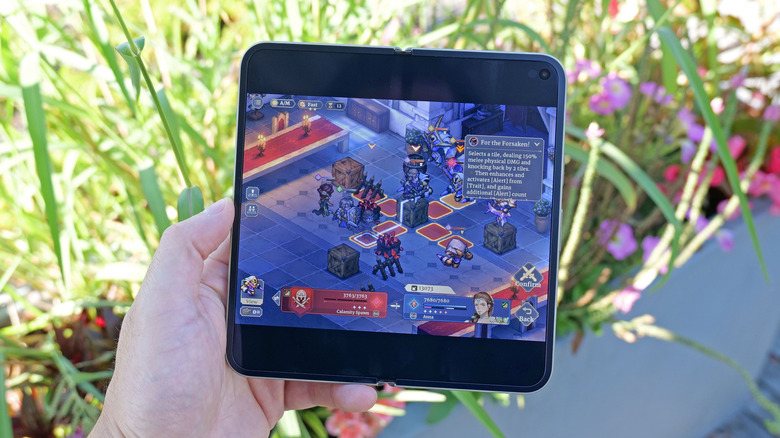
Google's Tensor chips have long been maligned by gadget nerds for not offering the same kind of clockspeeds or general performance you get from the Snapdragon processors in rival devices. And despite some notable jumps in speed, including 25 percent quicker web browsing and 15 percent faster app loading times, Google's new Tensor G6 probably won't do much to change those opinions. That said, even when loaded up with tons of apps running in the background and a split-screen multitasking going on up front, the P11PF never felt slow or sluggish. Most games including my current go-tos such as Sword of Convallaria and Pokemon Champions run quite smoothly too. The one issue is that framerates still lag behind just a touch for more demanding titles. Thankfully, even with the global RAM shortage, all versions of the Pixel 11 Pro Fold come with at least 16GB of RAM and 256GB of storage, so there's no drop in base specs like you get on the standard Pixel 11 Pros this year.
Cameras: Still the best among foldables
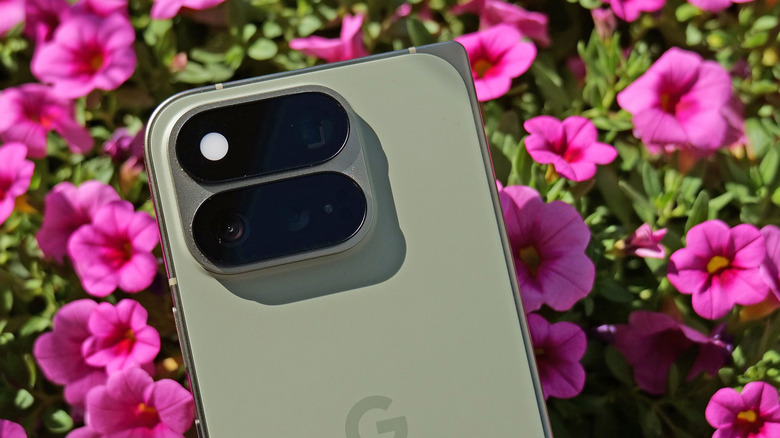
Between Night Sight mode and its 5x optical zoom lens, last year's phone already offered the best image quality of any foldable. This year, Google has extended its lead by giving the P11PF a new 48-megapixel sensor for its main camera that's larger than before along with a bunch of new tools and features.
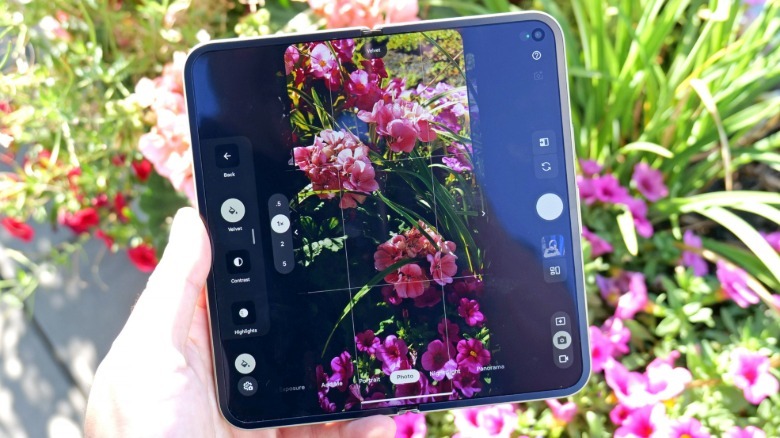
Pics snapped in both bright and low light environments were consistently sharper and more detailed than what I got from all of its rivals and I really appreciate Google's new slate of Camera Looks, which allow you to easily pick and customize a handful of onboard color profiles to match your style. Granted, I still prefer Google's default Natural option as it seems to be the most accurate setting. However, it's really nice to be able to quickly switch over to something like Shadows to get a dramatic pic with increased contrast or Digi, for a more nostalgic look that reminds millennials like me of simpler times.
 Sam Rutherford for Engadget
The other big addition to this year's Pixels is Google's Magic Capture. Instead of needing to hit the shutter button every time you want to record something, you can simply press the dedicated button for Magic Capture, point the phone at your subject and let the phone's AI record the best moments. The result is a handful of images and a single video that often highlights the interesting thing that happened, though things can be a bit hit or miss. I've found that Magic Capture excels when shooting things like sports or dancing, as the P11PF does a good job of saving dynamic poses without you needing to worry about if you hit the shutter at the exact right time. I just wish the processing time for videos was shorter.
On the flipside, when I used Magic Capture to record my four-year-old bouncing around at an indoor playscape, it struggled to grab a nice shot of him going down various slides, though it did end up getting something decent after several attempts. Aside from that, I noticed that occasionally, the phone would automatically suggest when an image needed to be rotated or cropped, which is a small but nice bonus when you're curating your camera roll.
My gripe is that while Super Res Zoom can extend the phone's 5x optical zoom to up to 30x digitally, that's still a far cry from the 120x magnification you get from the regular Pixel 11 Pro and Pro XL. Furthermore, the sensors for both the Pro Fold's telephoto (10.8MP) and ultra-wide cameras (10.5MP) are significantly lower resolution than what you get on a standard Pros too (48MP for the telephoto and 48MP for ultra-wide). I get that the P11PF's design makes it more difficult for it to receive the exact same sensors and components used in its siblings, but I feel like out of all the Android phonemakers out there, Google should understand the desire for photo parity across all of its Pro devices.
Other features: Rambler is the secret MVP
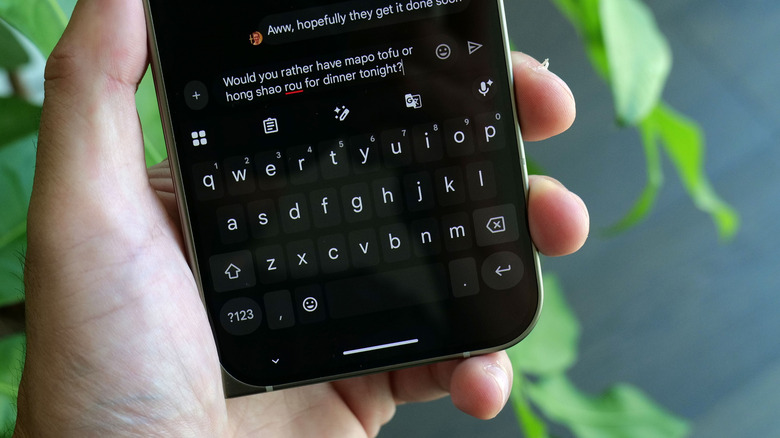
As with every new generation of Pixels, Google has equipped its phones with updated software including the ability to use Circle to Search inside the camera app, the all-new Creator Suite and more. But out of everything, these two stand out the most: bubble anything and Rambler.
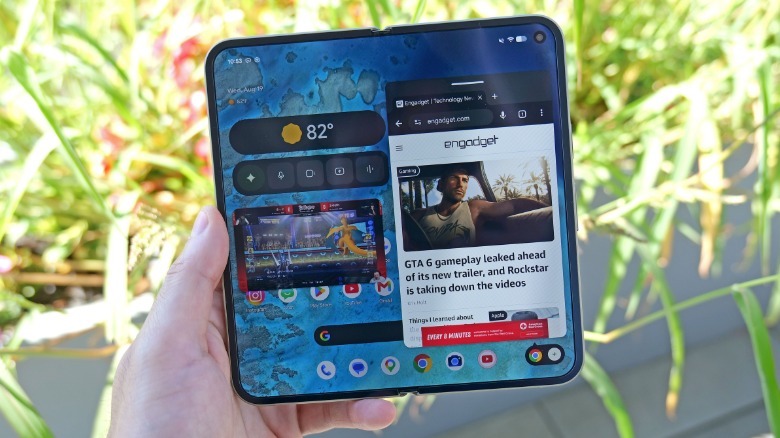
While bubble anything is available across all devices with Android 17, it's particularly impactful on the Pixel 11 Pro Fold because it gives you yet another way to multitask. Instead of opening apps in the classic side-by-side mode, you can also long hold on an app icon to bring up additional options including the ability to launch software in a free-floating window. In effect, this means almost any app can do the picture-in-picture thing you get from YouTube and other video players, which is perfect for keeping tabs on stuff like food deliveries while you watch a show or letting a text convo play out in the background while you get some work done. Using bubbles like this comes with another bonus in the form of a handy little app switcher that appears in the bottom right corner, making flipping between a small handful apps that much breezier than before.
 Sam Rutherford for Engadget
However, the real star of the Pixel 11 line is Rambler. It's part of the voice typing capabilities in the Google keyboard and not only does it cut out the randoms "umms" and "ahhs" that come out so often when you're speaking naturally, it also lets you switch seamlessly between multiple languages. Now as my editor Cherlynn so often reminds me, my Mandarin skills are scuffed at best. But even so, it lets me convert Chinese words (most often foods) like 木耳 or 紅燒肉 into text, so I don't have to say their longer and less descriptive English equivalent. And when I talk to my mom, it makes it easier for me to understand when she switches between both languages as well, which helps me retain what little skills I have left.
The one small drawback is that there aren't quite as many customization options as I'd like. Sometimes Rambler translates things into pinyin when I'm only saying a word or short phrase, but then it will do all characters when I say a full sentence. On top of that, Rambler currently defaults to Simplified Mandarin instead of traditional, though that will probably change because as good as it is already, Chinese technically isn't on the official list of supported languages. It still makes me a bit sad though because writing 愛 without 心 just doesn't feel right.
Battery life and charging: Less capacity with speedier wireless support
It's a bit weird when the battery capacity of a phone decreases year over year — especially with the rise of denser silicon carbon cells in competing devices — but that's what we're getting with the P11PF. Sure, it's not a ton with the latest model coming in at 4,806mAh compared to 5,015mAh for the Pixel 10 Pro Fold, but it's a drop nonetheless. Naturally, this had an impact on our local video rundown test. When using the phone's exterior display, the P11PF lasted 27 hours and nine minutes, which is shorter than all of its rivals including the Razr Fold (31:00), Z Fold 8 (28:14) and Z Fold 8 Ultra (32:11).
When it comes to charging, while wired speeds are staying the same at 30 watts, Qi 2 wireless speeds have gotten a significant boost from 15 to 25 watts, which is really nice for anyone who regularly uses a puck or pad. That said, the Razr Fold still leads the way with up to 50-watt wireless charging, just so long as you use one of Motorola's proprietary TurboPower accessories.
Wrap-up
The big issue for the Pixel 11 Pro Fold is that while a new chip, faster charging and an upgraded camera are all nice additions, I don't think Google has done enough to entice shoppers that aren't already entrenched in the Pixel ecosystem. HiLight is an interesting idea, but it's not fully built out yet and even when it is, I'm not sure it's the kind of signature feature that will convince first-time foldable buyers to go with Google's phone.
Sure, its chassis is a bit lighter, but the phone still feels big and chunky compared to its closest rivals. Speaking of the competition, the Razr Fold offers built-in stylus support and a much bigger battery. Meanwhile the base Z Fold 8 is sporting a slick new design and the Z Fold 8 Ultra offers the best performance and arguably the most well-rounded feature set of any flexible phone on the market.
Google's software experience is still the smartest of them all and it's one of the biggest things that will keep a lot of shoppers coming back. But the Pixel experience isn't something that exclusive to the Pro Fold and with not one but two upgraded sensors and 120x Super Res Zoom, the regular Pixel 11 Pros are better picks for discerning photogs. The Pixel 11 Pro Fold is a solid foldable phone, but I find that every time I pick it up, I often feel like I'd rather be holding one of its competitors.
Originally published on Engadget