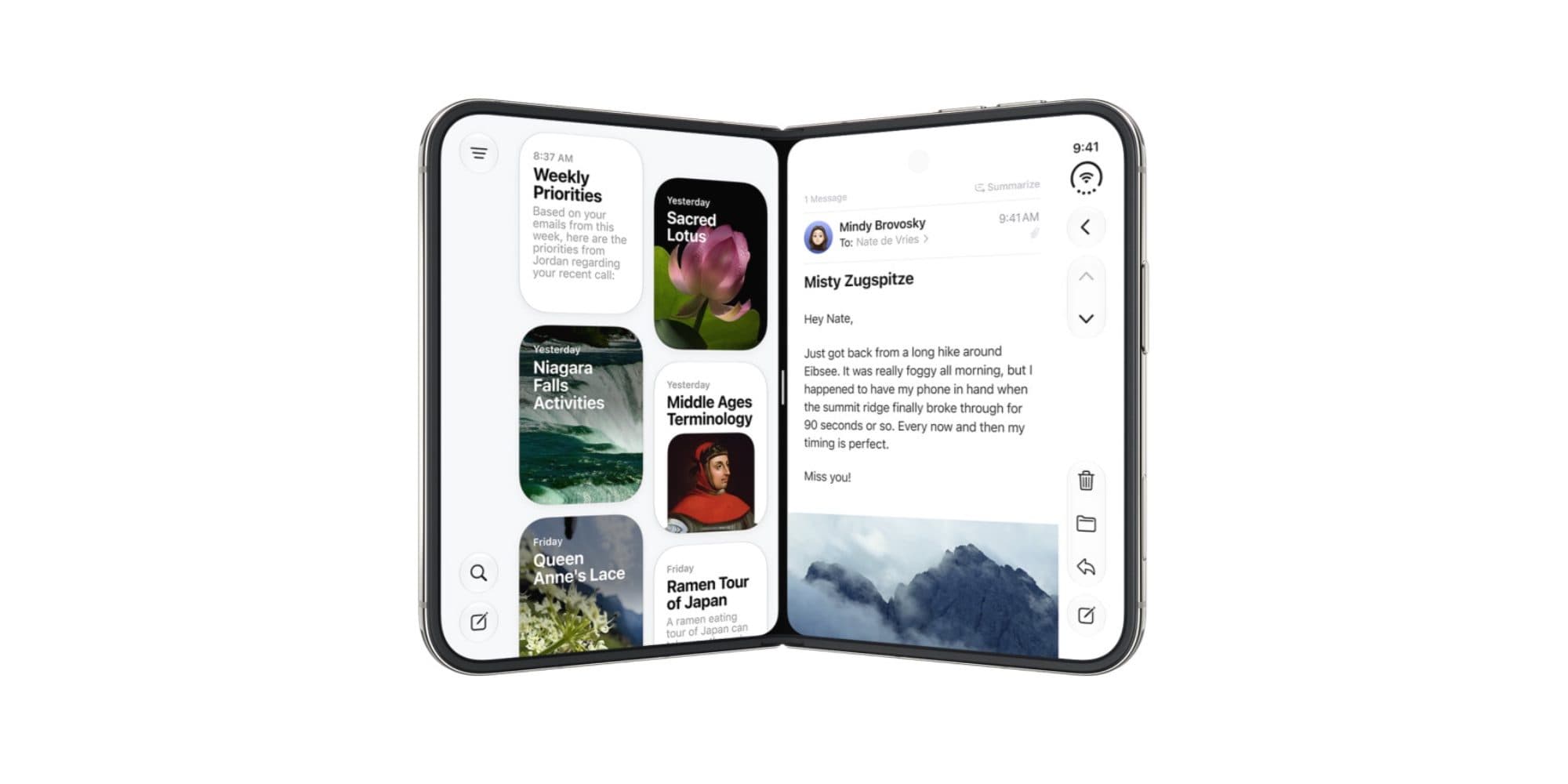
Like iPhone Air, iPhone Duo is a series of compromises that enable the thinnest iPhone to date, but that doesn't mean the camera system is bad. Here's what we know pre-shipment.
The iPhone Duo is Apple's first foldable and has four cameras, but unlike the iPhone 18 Pro, they're not the one's you'd expect. There are two rear cameras, an inner under-display FaceTime camera, and a front-facing selfie camera.
The camera system is unique and robust given the feature set it enables for iPhone Duo. However, nailing down exactly what we can expect from the cameras prior to hands-on testing isn't a science.
There is no doubt that the iPhone Duo will produce amazing photos in most common conditions. There will be some edge cases that it can't handle, and that's what I hope to uncover with this early comparison.
I'm an avid photographer and feel that I will miss what iPhone Pro models have always provided. Let's get into what is here, what isn't, and what that means.
iPhone Duo versus iPhone 18 Pro: Fusion Main camera
The most important camera on iPhone Duo is the one we don't have a direct comparison for. It's a unique combination of specs and features that don't quite let it line up with other iPhone cameras.

iPhone Duo has a comparable camera system to iPhone 18 Pro
No, it isn't quite the iPhone 17e or iPhone Air given the more powerful video capabilities. It also isn't the iPhone 17 Pro camera given its lack of support for pro features.
The 48MP Fusion Main camera on iPhone Duo is 26mm with an f/1.6 aperture. It has sensor-shift optical image stabilization and Hybrid Focus Pixels.
The iPhone 17 has the same 26mm camera with f/1.6 aperture and sensor-shift optical image stabilization. However, it has 100% Focus Pixels instead.
The iPhone Duo supports 4K Dolby Vision 120 fps video recording, while the iPhone 17 does not. The A20 Pro chipset and next-generation image signal processor likely plays a role in that.
The iPhone 18 Pro has a 48MP Fusion Main camera with variable aperture. It can change the aperture on the fly from f/1.48 to f/4.0.
It also has second-generation sensor-shift optical image stabilization and 100% Focus Pixels. Being an iPhone Pro, it also has all of the pro camera features, including the new Pro Controls.

iPhone 17 Pro Max has a set of pro features that won't be in iPhone Duo
iPhone Duo doesn't get access to a number of camera features.
- ProRAW
- ProRes video
- Apple Reference Image
- Spatial Photos
- Spatial Video
- Apple Log 2
- Genlock
- Academy Encoding System
It also lacks the studio-quality four-mic array.
However, most, if not all, of these features are niche or ultra-pro focused. Most iPhone users won't even know what these features do, let alone how to activate them.
What is available to iPhone Duo is the new Photographic Styles 3 with grain and texture control. There is also Dual Capture, Action Mode, Cinematic Mode, Slo-mo 1080p at 240 fps, Slo-mo 4K Dolby Vision at 120 fps, Night Mode, Portrait Mode, and macro photography.
iPhone 18 Pro is the high-end camera system with the most access, control, and features. However, the existence of a better camera system doesn't render iPhone Duo's worthless either.
Nailing down iPhone Duo's Main camera
People want to have a direct compare, but for iPhone Duo, it's not that simple. Unless Apple says something, or a teardown reveals additional details, we can only guess.

iPhone Duo has a unique Fusion Main camera not used anywhere else
The stand-out difference here is the lack of 100% Focus Pixels. Some suggest this means a weaker camera, but I'm not so sure.
There are multiple components that make up the iPhone camera system. Instead of this being some Frankenstein's monster containing a piece here and there from various iPhone cameras, I think the explanation is much more simple.
Apple called this the "new" Fusion Main camera system and later called the Fusion Ultra Wide the same as in iPhone 18 Pro. Simply put, this is a camera system unique to iPhone Duo and it may appear in future base iPhone models.
The example photos Apple offers are always incredible, so it is tough to go off of those. The camera metadata suggests the camera is incredibly fast, with an exposure time of 1/1092 and an ISO of 32 in broad daylight.
From what I can gather, the camera system is closer to iPhone 18 Pro than iPhone 17e, though we'll have to uncover this through testing and direct comparisons.
iPhone Duo versus iPhone 18 Pro: Fusion Ultra Wide camera
Apple was very clear about this during the iPhone Duo reveal — the Fusion Ultra Wide camera is identical to the one found on iPhone 18 Pro.

iPhone Duo's Ultra Wide camera is the same as on iPhone 18 Pro
They're both 48MP cameras that capture 24MP photos by default. Like with the Fusion Main camera, there are no pro features available for iPhone Duo.
The Fusion Ultra Wide camera enables macro photos, even on the iPhone Duo. The 0.5x magnification is also available for unique angles and shots.
Portrait mode takes advantage of the two-camera system as well, though iPhone Duo doesn't have a LiDAR sensor for added precision.
iPhone Duo versus iPhone 18 Pro: Center Stage front camera
When the iPhone Duo is closed, it has a front-facing camera in the top-right corner. It's 12MP, which is the same rating as the Center Stage camera found on iPad Pro — the only Apple device thinner than iPhone Duo.

iPhone Duo's front-facing camera is great for selfies and Duo FaceTime
The iPhone 18 Pro has an 18MP Center Stage front camera. That means selfies captured with this camera should be a little more crisp and a little bigger for your editing software versus iPhone Duo.
Other than the megapixel count, nearly every other spec and feature is identical beyond pro-level features only found on iPhone 18 Pro. The only spec included in iPhone 18 Pro's front camera that isn't in iPhone Duo's is focus pixels.
Interestingly, the selfie camera won't be your best option for selfies thanks to the outer display on iPhone Duo. You can take photos with the rear camera while seeing the viewfinder on the outer display.
The other cameras and features
Each iPhone has a camera the other doesn't have, which provides different capabilities. The iPhone 18 Pro has the Fusion Telephoto, while the iPhone Duo has the under-display FaceTime camera.

iPhone 18 Pro has variable aperture in the Main camera
The Fusion Telephoto camera has proven to be quite handy for getting close to a subject, but only in the most ideal conditions. It isn't a bad camera, but the dip in quality between it and the Fusion Main camera leave a lot to be desired.
Like with any iPhone photo, zooming with your feet will get you better results, even with optical-quality zoom.
Speaking of, the Fusion Main camera on iPhone Duo is capable of a 12MP 2x Telephoto shot. It's more of a crop, but the software utilizes the center of the sensor in a way that provides optical-like quality.
Apple is expected to include a Fusion Telephoto camera on a future iPhone Duo, but only if the components get small enough to fit in the thin device.
The fourth camera on the iPhone Duo is the under-display FaceTime camera. It's not going to be of any desirable quality for photos or video, but good enough for video calls.

No telephoto, but an under-display FaceTime camera can be found on the inner display
One other notable difference between the available sensors and cameras is the presence of a LiDAR sensor on iPhone 18 Pro. Like other standard iPhones, there isn't a LiDAR sensor on iPhone Duo.
The form factor offered by the foldable iPhone Duo does offer some unique features and possibilities.
Smart Take lets users stand up their iPhone and automatically capture photos when those in frame pose. Duo Preview lets those being photographed see the viewfinder on the outer display.
Another feature is the ability to capture from both the front and back cameras during a FaceTime call while showing the caller on both the front and back displays. This mode lets two people easily participate in a conversation.
What these specs mean for iPhone Duo photography
Let's get this out of the way. The normally pro iPhone users are going to immediately feel what's missing in iPhone Duo.
The lack of a good enough 4x and 8x camera will show up often enough to notice it.

iPhone Duo can prop itself up for photos
During my niece's recent birthday party, there were times when punching in a little further got some amazing shots. That's not going to be a possibility with iPhone Duo.
If 1x isn't enough, 2x is an immediate drop in quality, and everything beyond that is likely unusable. That's the primary loss of buying an iPhone Duo.
I created a smart album in Apple Photos to see just how often I used the Telephoto camera on iPhone 17 Pro Max. In the past year, I took about 210 photos with that camera, give or take.
Of those, only about a dozen were truly "I'm too far from the subject and can't get closer" shots. Think football games or stage productions for those.
The rest were almost universally photos I could have taken by walking closer.
Of course, that's not the only reason you would want to use a camera with 100mm of focal length or greater. By zooming in, you can get a more flattering portrait of a person, plus you can bring the background closer to the foreground.
Dropping the Fusion Telephoto camera will absolutely mean I won't get some shots. That said, I'll survive. It wasn't that long ago that the Telephoto camera on the iPhone was virtually useless, if it existed at all.
No pro features for iPhone Duo
Variable aperture is the new and shiny feature for iPhone 18 Pro. It's quite tempting, so much so, I'll be picking up a model to test the feature for a few weeks ahead of the iPhone Duo launch.

Variable aperture for iPhone 18 Pro
Variable aperture on such a small lens and sensor will only go so far. The results will be more pronounced in some situations, and less in others.
I expect that people will take some absolutely interesting shots on iPhone 18 Pro that would be impossible to capture on iPhone Duo. That f/1.48 aperture will outperform the iPhone Duo's f/1.6 aperture in low-light situations and in producing natural background blurs.
The thing is, those effects will only be noticeable if you've got the two cameras side-by-side to compare identical shots. The iPhone Duo will take great shots in most conditions, and of course the better-specced camera will perform better.
The lack of ProRAW and ProRes video is disappointing, if understandable. However, those aren't features I turned to on any regular basis, if ever.
After Apple introduced Photographic Styles that could be changed or reversed, I was sold on that format. I don't feel a need to capture in RAW and edit afterwards when I can get what I want at the output.
Of course, if I need a RAW format or other pro control options, I don't need Apple to provide it for me. Halide, Obscura, and other third-party camera apps will give me plenty of options for iPhone Duo.
That doesn't mean the iPhone Duo will be bad at taking photos or capturing video.
iPhone Duo will still be great for video
As always, the iPhone's video specs are incredible, even for the foldable. 4K Dolby Vision at 120 fps is great and will be overkill for most situations.
I will miss the ability to capture spatial video. While the quality wasn't great at 1080p and 30 fps, some situations were amazing in that format.
I expect Apple will introduce a way to automatically convert a recorded video to spatial video, just as it has enabled a toggle for Cinematic Mode, even when the feature wasn't in use when the video was recorded. Once your 4K content can be converted to spatial, there will be zero reason to record it in the inferior 1080p format.
iPhone Duo will be an excellent camera
The camera specs are of a quality and range expected of a premium iPhone. I doubt I'll have any trouble capturing photos and videos with iPhone Duo, and the new features like Smart Take will offer a unique experience.

Features like Kid Cue give iPhone Duo an alternative set of advantages
I'll be running a lot of tests and comparisons throughout the fall once I get my hands on iPhone Duo. I had once considered I may need a dedicated pocket camera to replace the performance and range of a pro iPhone.
A pocket camera that is competitive with an iPhone Pro costs more than $1,000 on the average, so I'm not excited about it. I'd prefer it if iPhone Duo could manage all of my portable camera needs.
I already own a large-format Sony A7II, which is amazing even a decade on. It's just too big to be a realistic portable camera and iPhone camera alternative.
Apple's presentation and early impressions leave me hopeful. I previously believed it was a done deal and I'd need an alternative portable camera in order to compensate for the foldable iPhone.
Now, I'm fairly confident I won't need a secondary or alternative camera. I won't pass judgement yet, but the specs show iPhone Duo should be a great iPhone camera, even if it doesn't have all the pro bells and whistles.
Truly, all anyone might miss is the Fusion Telephoto camera. If that's a must, it'll be added to an Apple foldable in a generation or two.
As Mike keeps saying, physics are remorseless. There's only so much physical space inside an iPhone Duo, so we'll see what develops in the next five years or so.