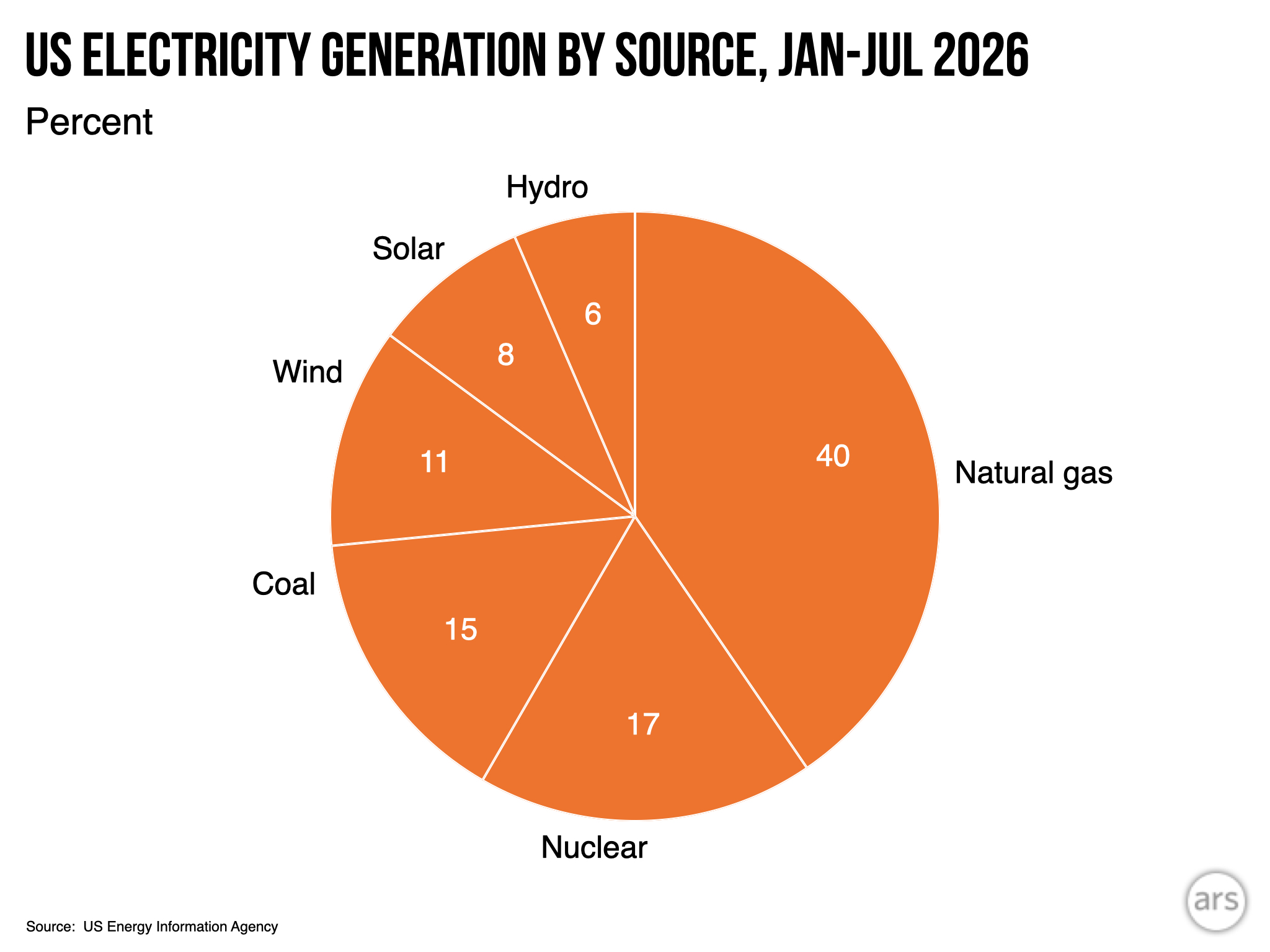
Share of the US electricity generation by power source. Numbers may not add up to 100 percent due to the existence of minor sources like geothermal and diesel generation.
Credit: John Timmer
Share of the US electricity generation by power source. Numbers may not add up to 100 percent due to the existence of minor sources like geothermal and diesel generation. Credit: John Timmer
Adding in hydro means that renewables now cover 27 percent of demand. With nuclear, that adds up to the US covering 45 percent of its electricity use with non-carbon-emitting sources. For comparison, the EU generates about 30 percent of its electricity using wind and solar, and 65 percent is emissions-free. (That rises to 71 percent if you count bioenergy, which is largely carbon-neutral, but not emissions-free.)
What’s next?
The Energy Information Agency, which provides all the grid data, also keeps track of what they expect to be hooked up to the grid over the coming months, which provides some perspective on what we might expect to see over the next year. The latest version of this highlights a couple of trends and one almost-trend.
The almost comes in the form of two large offshore wind projects that will be completed off the East Coast, including a 2.6 GW monster off Virginia. The Trump administration has paid off developers to stop building anything similar, so these will likely be the last of their kind until the 2030s. Onshore wind development has continued throughout the Midwest and Plains regions.
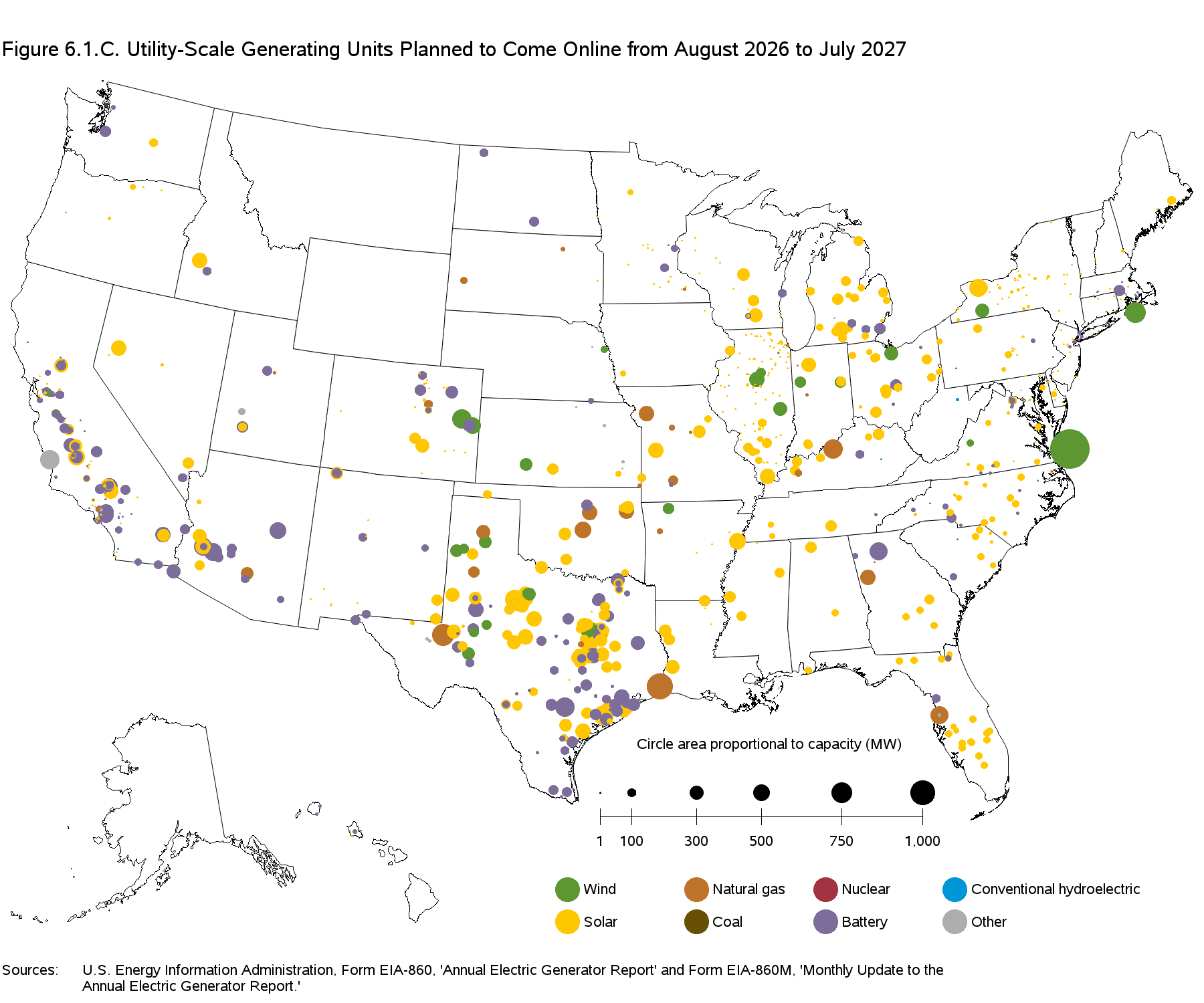
A map of the US with colored dots indicating the presence of new generating facilities and their technology.
A map of the US with colored dots indicating the presence of new generating facilities and their technology.
Credit: US EIAThose areas, along with the South, are also seeing a lot of solar development. This includes some significant facilities in Michigan and Wisconsin, which were probably too far north for the economics to have worked out just a few years back. Another notable change is that battery installations are starting to spread beyond the hotbeds in California and Texas. Arizona and Colorado are seeing a number of grid battery installs; the new solar in Michigan will be paired with a few, and there’s a large one expected to come online in Georgia.
A smattering of new natural gas plants will be coming online, mostly throughout the Midwest and Texas. No new nuclear or coal plants will be completed; it has now been 13 years since the last new coal plant came online in the US, and none are currently being developed.


