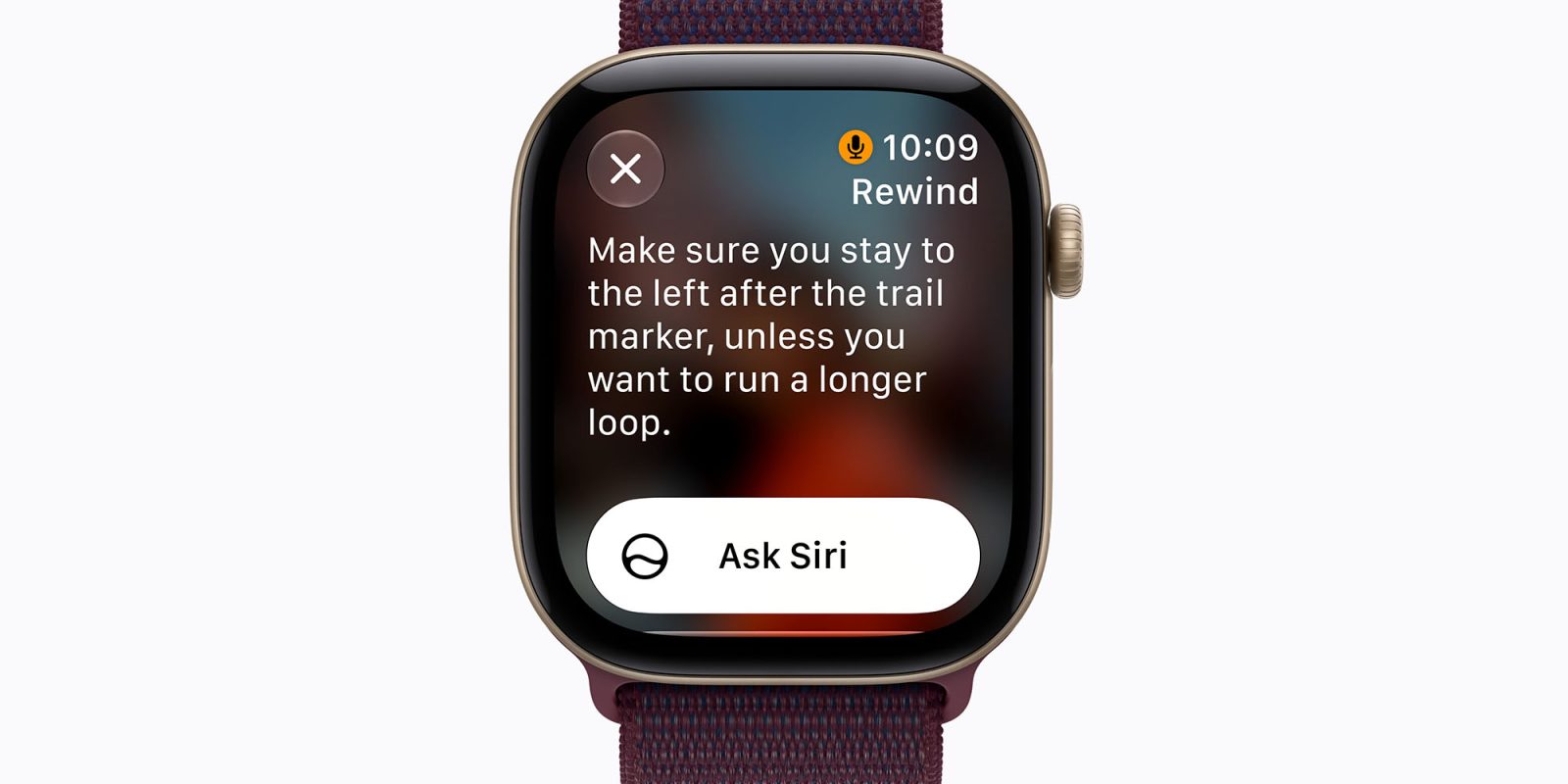
Two new Apple Watch features may see the device running up against privacy laws in multiple US states. That’s because the new Live Rewind and Siri Recap features audio-record conversations.
The devil is very much in the detail here, since neither feature makes audio recordings accessible to anyone, and it seems likely that the issue will need to be tested in the courts in order to set a new legal precedent …
Live Rewind and Siri Recap
Apple announced that the latest Apple Watch models support four new audio intelligence features that use the microphones built into the wearable devices:
- Sound Recognition, to recognize sounds like doorbells and fire alarms
- Music Recognition, powered by Shazam
- Live Rewind, to transcribe what was just said if you missed it
- Siri Recap, high-level summaries of conversations
It’s the latter two that create the potential privacy controversy, since they involve recording what both you and those around you are saying.
The law on audio recordings
Whether and when it is legal to audio record conversations depends on the state or country in which you live.
Many US states have what is known as a two-party consent requirement. That is, everyone involved in the conversation needs to know that it is being recorded and to give their consent to this. In these states, it wouldn’t be legal for you to use any device to record a conversation with someone else without their awareness and agreement. (There are some exceptions for law enforcement, but these aren’t relevant here.)
In these states, if the Apple Watch were storing audio recordings and making them available for replay, then the law would be clear: consent is required. The complication here is that Apple very explicitly says that this is not the case.
Apple’s privacy measures
Apple clearly gave a lot of thought to privacy, and we recently discussed what the company has said about each feature.
Neither feature operates in the background by default; each has to be enabled. Live Rewind has to be activated every single time you want to use it, and only operates for 15 seconds. Absolutely nobody gets any access to the audio recordings, which are stored only in a secure exclave chip.
If a conversation is detected, audio flows into a protected buffer inside the Secure Exclave on the S11 chip. It is isolated in hardware so that it is inaccessible to the user, the operating system, apps, and even Apple.
The recordings are only stored temporarily, and deleted as soon as they have been used, either to generate a transcription or to include in a summary.
The legal uncertainty
Despite these measures, however, Bloomberg reports legal experts highlighting the uncertainties created by the new features.
Bloomberg’s Natalie Lung put the question to attorneys in California, Massachusetts, Pennsylvania and Washington on 11 September. Those states generally prohibit intercepting a private or confidential conversation without the consent of everyone involved […] None of the lawyers she spoke to was convinced that Apple’s protections would shield a wearer […]
Speech processed continuously, with no conventional recording at the end of it, may still count as interception under state law.
Phil Lauer, a defense attorney in Pennsylvania, said the technology is “very close to being legal, because it’s not an individual who is actually receiving and using this data.” But, he added, “the argument can be made that it’s unlawful” because the device is picking up audio and interpreting it.
“Whether the courts will see it that way, given all the sort of privacy protection things that Apple has used, that’s an interesting question and it’s going to be coming up,” Lauer said.
9to5Mac’s Take
This is yet another example of the law lagging behind technological capabilities. If an audio recording is used to generate a transcript or a summary without that recording ever being accessible to anybody at all, does it violate laws forbidding recordings? The short answer appears to be: nobody knows.
The Live Rewind feature seems particularly benign. It is literally only able to be used to capture the last 15 seconds of what somebody said, and generates an audible alert when it is used, even if the Watch is in silent mode or connected to headphones.
Ultimately, the issue will likely need to be tested in court. The dilemma for Apple Watch wearers is that it is they, and not Apple, who would be held legally responsible should a court rule that the new features are covered by these laws.
Image: Apple
FTC: We use income earning auto affiliate links. More.