NVIDIA data center hardware is being cooled with water 'hotter than a hot tub'
It may seem counterintuitive, but 113-degree water is still cool enough to cool NVIDA's latest hardware.
NVIDIA data center hardware is being cooled with water 'hotter than a hot tub'
It may seem counterintuitive, but 113-degree water is still cool enough to cool NVIDA's latest hardware.
Here's a question you probably didn't expect to read today (or ever): what do AI supercomputers and hot tubs have in common? Sounds like the start of a joke, doesn't it? The truth, however, is that while a hot tub runs at around 38 to 40 degrees Celcius, NVIDIA'S newest AI servers push their "cooling" liquid even hotter, all the way up to 45 degree Celcius, or 113 degrees Fahrenheit.
It may sound backwards, because how can running hot liquid cool down server rooms? The old approach had data centers pour tons of energy into chilling air, then pushing the cold air across every component, running loud fans and chillers just to keep chips comfortable. Now, when coolant runs hot, outdoor dry coolers can shed heat on their own without requiring chillers. Once you understand how all of this works, you'll find the old way of cooling data centers pretty wasteful.
More budget friendly, more climate-friendly
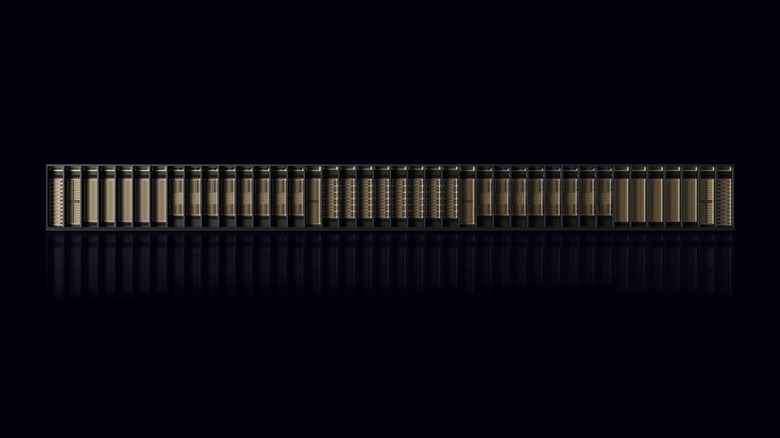
NVIDIA's Rubin generation of AI infrastructure is fully liquid-cooled. No fans, no cold aisles, no walking into a freezer when you're in the server room. Just liquid circulating quietly through a closed loop. This is a major update because, historically, cooling has eaten up as much as 40 percent of a data center's electricity bill. Industry estimates indicate that raising chiller temps by just one degree cuts cooling energy costs by around 4%. Scaling that up to a 50-megawatt facility and you get about $4 million savings in energy a year.
The water savings are just as striking. Conventional cooling-tower systems can consume roughly 2.6 million gallons of water per megawatt per year. NVIDIA's new 45-degree liquid cooling architecture can bring the number down to nearly zero.
That's a complete overhaul of the cooling system on massive data centers. A closed-loop system with no evaporative cooling, no water towers and no ongoing water drain won't just have an impact on data center costs, but also on the environment.
An overhaul of data centers

For decades, the data center industry has worked on the assumption that cold equals safe. The cooler the room, the better. But silicone chips run hot by nature. NVIDIA's data shows that coolant entering a fully liquid-cooled processor at 45-degrees Celsius exits at around 55 degrees after absorbing the chip's heat load. The chip keeps running at full performance because liquid-cooled cold plates keep everything within safe operating limits. This also allows outdoor dry coolers to reject heat efficiently for most of the year, without the need of mechanical chillers. Of course, geography plays an important role here too, because you can't have the same temperature management expectations in the desert as you do in the mountains.
That will also translate into more silent data centers. Normally, you need ear protection inside data centers to keep down the loud noises produced by cooling fans, backup generators and cooling systems. NVIDIA's Rubin architecture drops all that.
NVIDIA's Rubin gear doesn't just cut down costs on energy and water consumption and reduce noise levels. The servers are also more space efficient. Thanks to their design, a system that used to take up six rack units now fits in two.
Ultimately, NVIDIA's new server architecture has the potential to solve some of the most annoying problems about data centers, such as their high energy consumption, massive water usage, noise pollution and land use. This doesn't fix problems with existing data centers, but hopefully will lead to improved ones in the future.
Originally published on Engadget