Apple's head-mounted hardware plans are slowly being cut, reportedly by new CEO John Ternus himself, with Vision Air said to be killed off alongside Display glasses.
The Apple Vision Pro was supposed to be the first salvo in a new platform for Apple to dominate. However, Apple has reportedly made some moves to curtail its ambitions for the head-wearable future.
In an X post on Wednesday, analyst Ming-Chi Kuo of TF Securities has admitted that his Apple headset and glasses roadmap from one year ago is no longer a useful reference. Instead of many products on the horizon, it's been pruned down to just two smart glasses.
Minutes later in reply, Bloomberg's Mark Gurman chimed in, explaining that the Vision Air was killed off back in October 2025. Display glasses were also off the table in January 2025.
What's left are two more glasses, with AI glasses expected at the end of 2027. The other, the full-blown AR smartglasses referred to as Apple Glass, is apparently due at the end of the decade.
As for a proper follow-up to the Apple Vision Pro, Gurman adds that it is in testing, but the category is "on ice."
Trimming by Ternus
Based on Kuo's commentary, Apple's incoming CEO John Ternus is at the center of the scheduling and possible cancellations.
Kuo writes that the overhaul was "signed off" by Ternus, but not recently. Apparently, it was a shift that happened "a while back," rather than after being named the successor to current CEO Tim Cook.
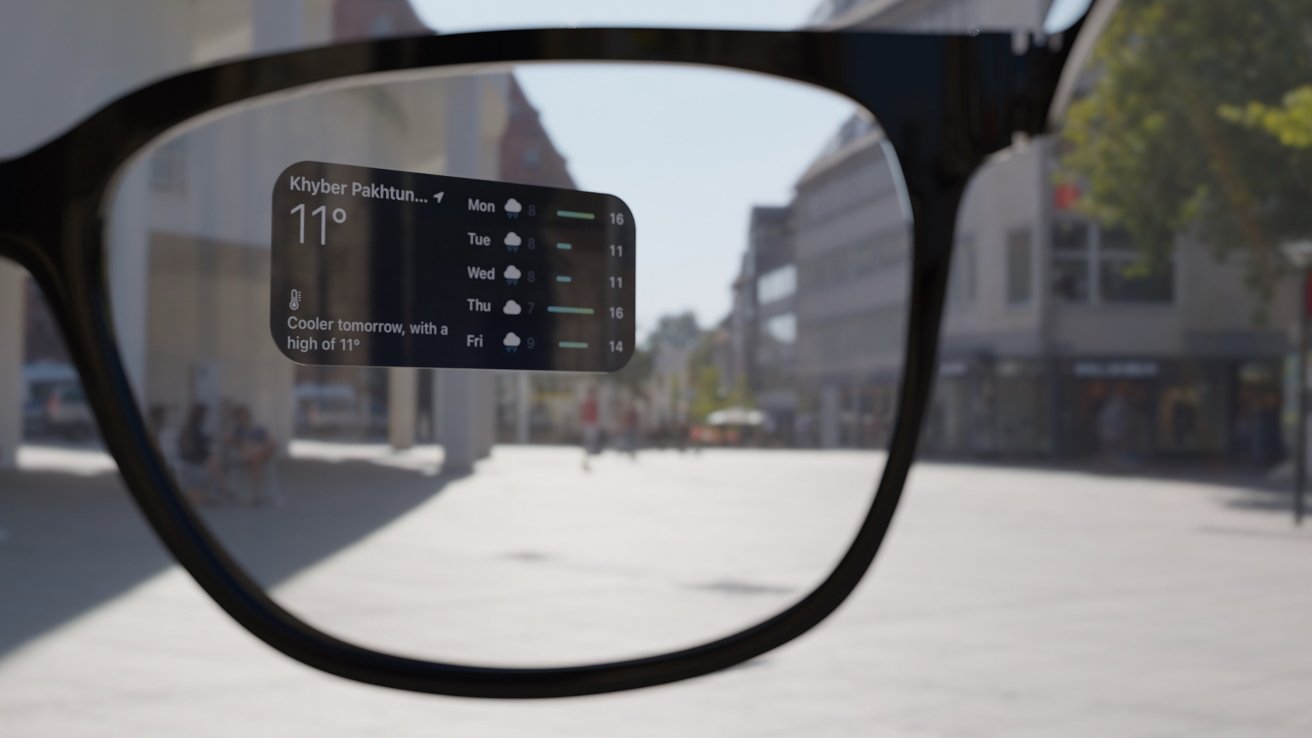
Apple Glass in its AR form would help by showing you the weather, among other tasks.
The culling of the Apple Vision Air, a lightweight and considerably cheaper version of the Apple Vision Pro, was the "right call" in Kuo's view. The change lets Apple shift its resources to smart glasses, which have a greater mass-market potential for the company.
Price and necessity were probable factors in the decision. A massive market of spectacle wearers paying a few hundred dollars for AI-equipped frames will certainly generate higher sales numbers than a $3,499 headset.
As for those glasses, Kuo's supply checks say that the display glasses have slipped to 2029, but will use optical waveguides. The non-display AI glasses, similar in concept to the Ray-Ban Meta, is thought by Kuo to still be coming in 2027.
The writing's visible on the wall
While Kuo and Gurman unofficially confirm that Apple is changing course over its head-mounted future, it's something we have suspected for some time already.
In February, our retrospective on the Apple Vision Pro discussed how, despite two years of availability, there wasn't really a "killer app" for the device. For all of its flaws, and an upgrade to the M5 for processing, the biggest issue it has is too few sales.
Without the numbers, there's no incentive for a developer to produce apps, which would eventually result in someone making an app everyone would want to try. But, since such an app doesn't really exist, there's no incentive for consumers to buy the Apple Vision Pro in the first place.
It's a catch-22 situation, but with VR.
The October 2025 report of Apple supposedly shifting attention away from the Vision Air in favor of smart glasses didn't help matters either. But it's not the only future product type to impact the headset strategy.
There's also the prospect of the AirPods Pro with built-in cameras on the horizon. A product that could provide the same sort of experience as AI-equipped smart glasses, but without the glasses bit.
There are also more fanciful predictions of a wearable pendant or AI pin, which are also wearable items that provide the AI smarts without the headset or smart glasses.
Evidently, Apple is working on many ways to give users the benefits of an AI-directed future, without necessarily counting on the seeing-things bit. That's a problem for anything headset-shaped that's in development.