Powering on
To try running the Adélie power plant anyway, the team redeployed it to a nearby natural vent where hydrothermal fluid was already flowing out at about 538° F (281° C). On September 27, they gave it a try.
Over nearly half a minute, the power plant turbine reached about 26,000 rpm and enabled the generator to produce 60 watt-hours of electricity.
The power plant also became net-positive by producing more electricity than it consumed for about 8.7 seconds. It produced a median of about 2 kilowatts of net power and peaked at 16.5 kilowatts of net power.
“It’s the proof point,” Redd told Ars. “Net-positive is the threshold that matters: the plant made more power than it took to run itself on the seafloor, which no one had done before.”
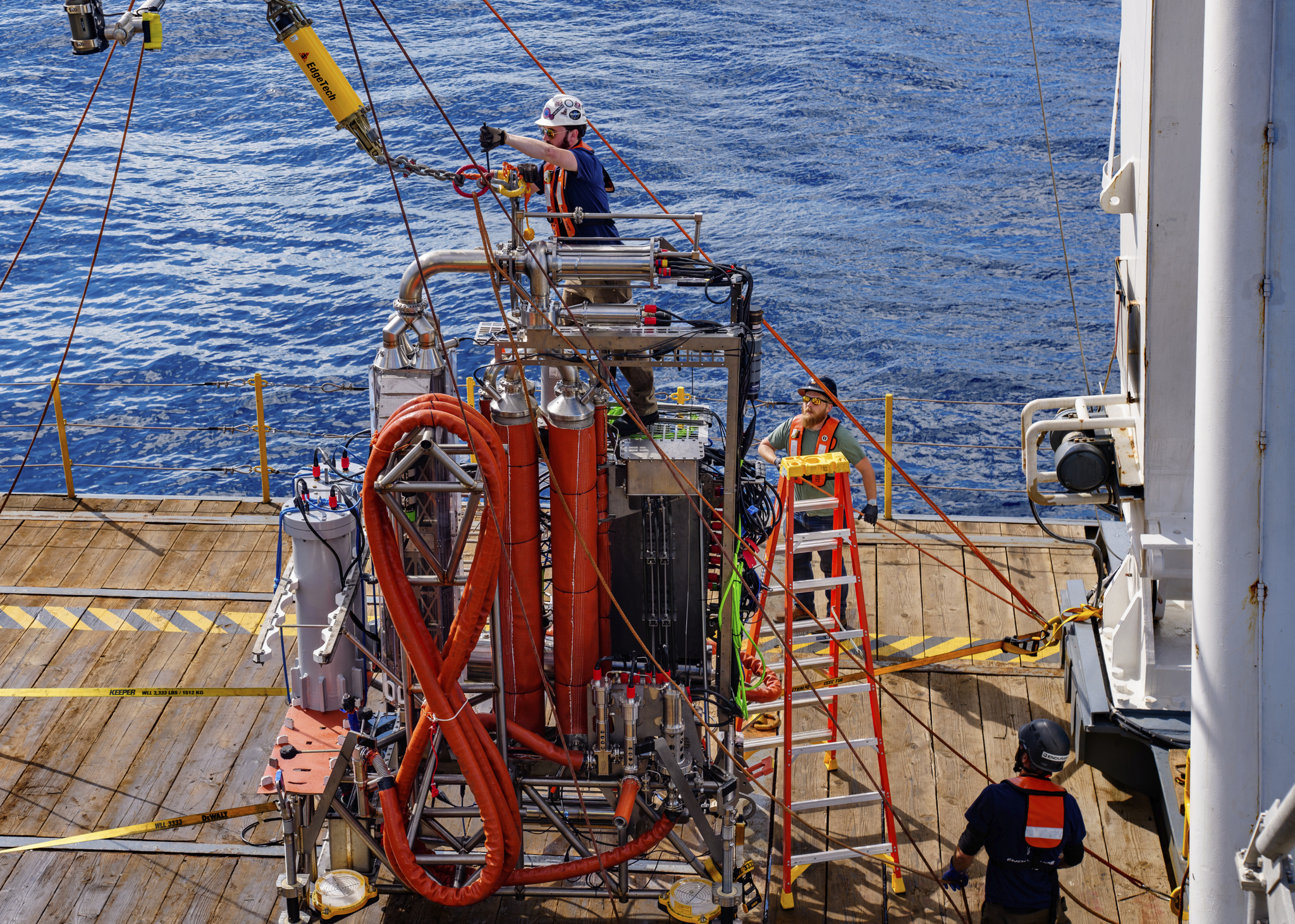
The 100-kilowatt power plant named Adélie was designed to tap geothermal energy from the seafloor.
Credit: Endurance Energy
The 100-kilowatt power plant named Adélie was designed to tap geothermal energy from the seafloor. Credit: Endurance Energy
But then a software issue brought the power run to a halt. Before the generator takes over, Adélie first relies on a battery to run its pumps, thrusters, and controls, along with spinning the turbine to get it up to speed, Redd explained. A battery module recorded a brief spike in current during the spin-up process and then stopped reporting.
That prompted Adélie’s software to automatically stop the power plant as a safety precaution, because it kept relying on the old reading from the battery module.
When the team was restarting the power plant, a power cable feeding the refrigerant pump also failed when an imperfection in the cable casing allowed seawater to seep in and short two of the electrical conductors. That ended the trial run, although Endurance Energy already plans to use the experience to improve how it builds and tests subsea cables.
Future deployments
Placing the geothermal plant on top of a natural hydrothermal vent was a one-time test for purely research and demonstration purposes, Redd said. His company still plans to rely on drilled wells in future deployments.