Steam Deck vs. Switch 2 — which gaming handheld is more powerful?
The Switch 2 is newer and more affordable than the Steam Deck, but Valve's console still has serious power to draw on.
Steam Deck vs. Switch 2 — which gaming handheld is more powerful?
The Steam Deck and Switch 2 both have their advantages, but which should you choose for greater raw power?
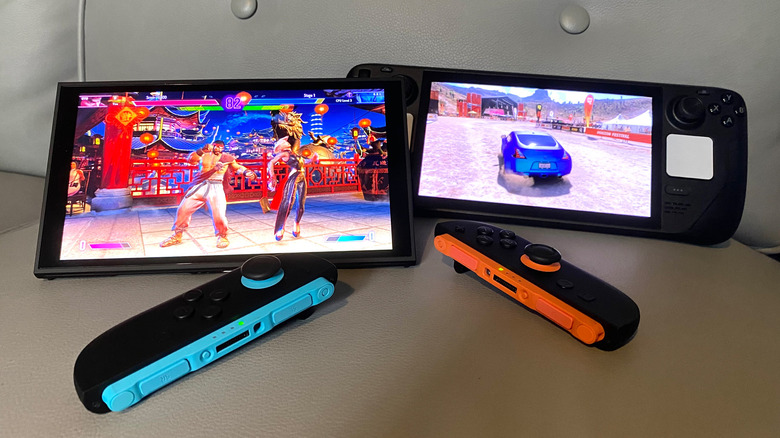
The Steam Deck and Nintendo Switch 2 are very different handhelds. One is focused on bringing PC gaming into the palm of your hand, while the other delivers a hybrid experience where you can easily bounce between big-screen and handheld play. But which of the two portable machines is more powerful?
In terms of raw numbers, there's not actually much to separate the Steam Deck and Switch 2's GPU and CPU performance in the latter's handheld mode. Where Nintendo's system pulls ahead is with the docked experience. Docking the little console dramatically ups the GPU clocks it can tap into, which is why some of the best Switch 2 games can be played in 4K on modern TVs.
The Steam Deck vs. Switch 2 power debate is pretty nuanced overall, so let's get into the areas where each system has an advantage.
Is the Switch 2 more powerful than the Steam Deck?
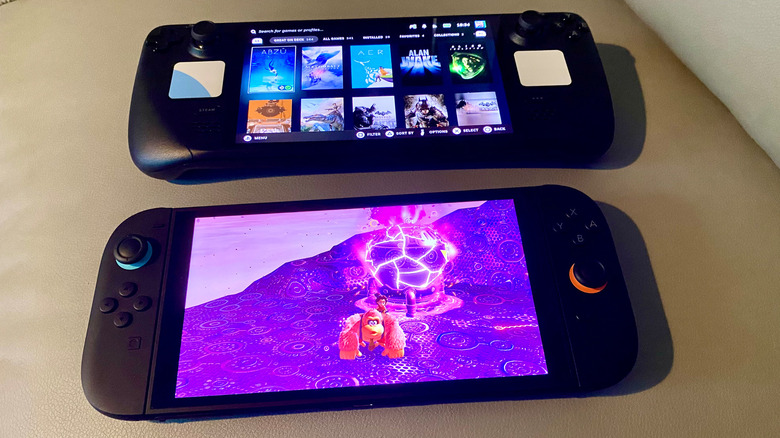
In most instances, it is. There isn't a huge difference in sheer polygon-pushing grunt with the Switch 2 in handheld mode compared to Steam Deck. Yet once Nintendo's hybrid system is connected to its dock, the power gap increases significantly. When you compare both systems' internal components, the difference between the two portable machines is surprisingly small.
On the GPU front, the Switch 2 definitely has a slight edge over Steam Deck. Its Nvidia Ampere graphics solution is capable of delivering 4K/60 fps gameplay in games like Metroid Prime 4, mainly thanks to Nvidia DLSS (more on that shortly). The Deck's AMD RDNA 2 GPU isn't quite as accomplished, but it's still up to the task of handling Elden Ring at 720p/30 fps, which looks decent on the Deck's crisp and vibrant panel.
The Switch 2 can really pull away in power when docked. In portable play, the Nintendo console's GPU tops out at around 1.71 TFLOPS, which isn't much faster than Steam Deck's 1.6 TFLOPS GPU. It's a much different story with docked performance, where Switch 2 can draw up to 3.7 TFLOPS of compute power. This is a big reason why it can handle 4K gameplay. In contrast, the Steam Deck doesn't gain enhanced performance when docked.
Flipping to both handhelds' CPUs, it's the Steam Deck that has the advantage. Though the Switch 2's ARM Cortex-A78C processor has double the cores of the Deck's AMD Zen 2 chip (eight vs. four), the CPU in Valve's little system has a clock speed that can be cranked up to 3.5GHz. That's substantially faster than the 1.1GHz the Switch 2's CPU normally clocks in at.
However, the Switch 2's ARM-based processor is more modern than the Deck's Zen 2 chipset, so even though Valve's handheld can draw on higher clock speeds, Switch 2's CPU remains competitive performance-wise. Where Steam Deck pulls ahead again is on the memory front: it has 16GB of unified memory compared to Switch 2's 12GB.
Are Switch 2 games better optimized than Steam Deck games?
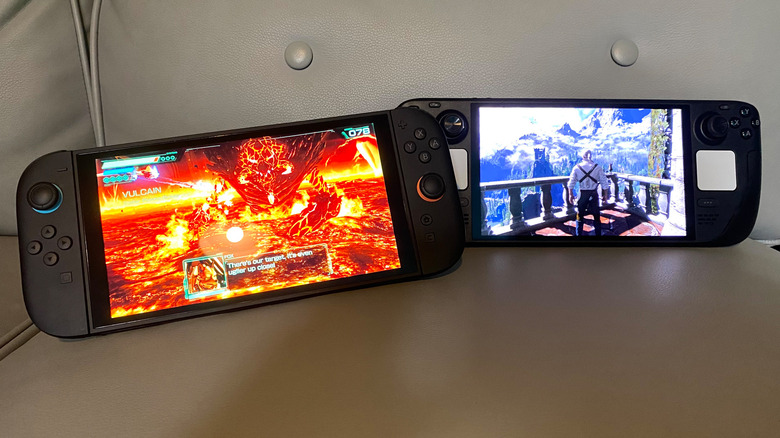
Generally speaking, yes. That's largely because the Switch 2 is a fixed platform — developers know exactly what hardware they're tailoring games for. The Steam Deck is different. Even though Valve's portable PC also uses fixed components, studios don't design PC titles to run smoothly on the Deck by default. The Steam Deck Verified filter lets you know which games run well on the system without needing major graphical tweaks, but for a lot of modern titles, you'll have to lower settings to hit stable frame rates.
The real optimization ace up the Switch 2's sleeve is DLSS. Nvidia's upscaler allows devs to choose a relatively low internal resolution before Team Green's supersampling uses AI to bump up image quality. That's how Cyberpunk 2077 can hit 1080p when Switch 2 is docked. The fact that Nintendo's console also has over 1,500 CUDA cores means it can handle ray-tracing in games like Star Wars Outlaws. While Steam Deck can technically handle RT, without dedicated CUDA cores, the advanced rendering feature obliterates performance on Valve's machine. Regardless, we still consider the Deck to be one of the best handheld gaming systems.
Should I buy a Steam Deck or a Switch 2?
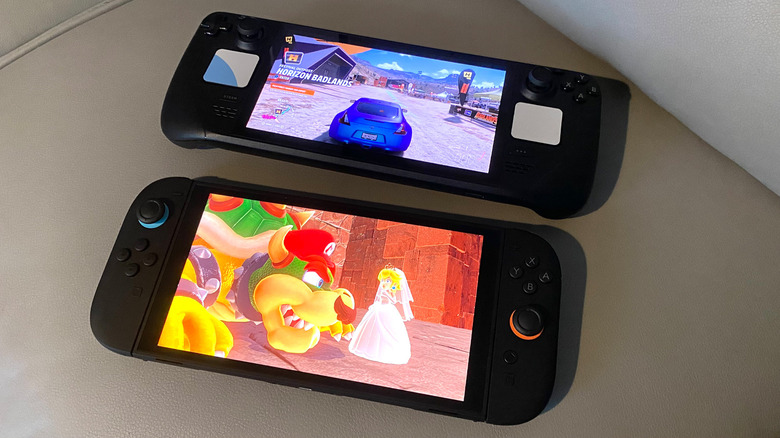
This is a subjective question that boils down to your specific gaming tastes, though arguably the biggest practical difference between the two handhelds is their price. After Valve jacked up Steam Deck prices by as much as $300 (thank you very much, RAMaggeddon), its teeny PC now costs significantly more than a Switch 2. If you want the base 512GB OLED Deck, you'll have to pony up an eye-watering $789. The 1TB model is $949, which is more than a PS5 Pro. By contrast, the $499 Switch 2 almost looks like a bargain.
Of course, there's more to the cost variables than just the hardware. Though the Steam Deck OLED is now considerably more expensive than when it arrived in late 2023, daily Steam sales mean it's much easier to buy discounted games for Valve's handheld than it is for Switch 2. While the Nintendo eShop offers regular sales, flagship first-party titles like Mario Kart World or The Legend of Zelda: Tears of the Kingdom rarely drop in price. And when they do, the discounts aren't as drastic as what you'll find on Steam.
At the time of writing, the iconic plumber's arcade racer still retails for $79 (you could easily buy half a dozen games on Steam for that). If you value must-buy Nintendo exclusives such as Donkey Kong Bananza, Switch 2 is the handheld for you. But if you'd rather build an expansive game library of older titles and indie gems for relatively little money, a Steam Deck is the better bet.
Outside of price concerns, you also have to factor in how you want to play your games. The Switch 2's plug-and-play dock makes switching between TV and handheld play a breeze. While you can buy a dock for your Deck (another $79) and hook it up to a big screen, the experience is still not as user-friendly as navigating around Switch 2's home screen.
As a handheld hybrid, Nintendo's console is more naturally fitted for living room play. For pure handheld gaming though, the Steam Deck's vastly superior OLED display (Valve no longer makes the original LCD model) gives it an edge over the Switch 2. While the screen on Nintendo's system is slightly larger and 1080p (compared to 1,280 x 800 on the Deck), its LCD display is a step down in picture quality.
Originally published on Engadget