On August 24, 2011, just six weeks before his death, Apple cofounder Steve Jobs announced his resignation as CEO. On the eve of his own leaving,Tim Cook now seems to have been his obvious successor, but back then, he was an unexpected and even controversial choice.
Steve Jobs' resignation followed a previous leave of absence from the company starting in January 2011, during which Cook had served as acting CEO. Jobs's formal stepping down was an unmistakable end of an era for the company, and a very different departure from the first time he had left Apple, in 1985.
The resignation followed a multi-year saga in which the executive was widely assumed to be in failing health. But, Jobs was not always forthright about the exact nature and severity of his illness.
The first battle
Jobs was first diagnosed with pancreatic cancer as long before as the fall of 2003. In an extreme example of Jobs' stubborn nature, he first fought his disease with alternative medicine, as well as a special diet.
Eventually, in the summer of 2004, Jobs underwent a surgery, known as a "Whipple procedure," that successfully removed the tumor. As Apple's Chief Operating Officer at the time, Tim Cook assumed Jobs' duties on an interim basis during his leave and subsequent recuperation.
Jobs told Apple employees about the cancer shortly before his surgery, and disclosed the diagnosis and surgery after they happened. That information, and the rumors beforehand, had left many inside and outside of Apple, wondering about the company's future.
Even so, Jobs didn't address the cancer battle at length in any public way until his now famous commencement address at Stanford University in June of 2005.
"About a year ago I was diagnosed with cancer," Jobs told the Stanford graduates. "I had a scan at 7:30 in the morning, and it clearly showed a tumor on my pancreas. I didn't even know what a pancreas was. The doctors told me this was almost certainly a type of cancer that is incurable, and that I should expect to live no longer than three to six months."
"My doctor advised me to go home and get my affairs in order, which is doctor's code for prepare to die," added Jobs. "It means to try to tell your kids everything you thought you'd have the next 10 years to tell them in just a few months. It means to make sure everything is buttoned up so that it will be as easy as possible for your family. It means to say your goodbyes."
In an example, perhaps, of his famed "reality distortion field," Jobs' speech wasn't exactly an accurate depiction of the timeline, front-dating his diagnosis and leaving out the period of several months in which he used alternative treatments.
Despite that prediction of three to six months, Jobs actually appeared to recover well over the next couple of years. He recovered sufficiently that attention on his health lessened, though it never quite faded completely.
Health questions
The World Wide Developers Conference in 2006 was the first of several public appearances that caused whispers about whether Jobs was unwell. His appearance was yet to clearly show illness, but he was noticeably thinner than at the previous WWDC.
Plus some, including Forbes magazine, commented that his performance on stage wasn't as high-energy as it normally was at such events.
"Is Steve Jobs ill?," Forbes publisher and columnist Rich Karlgaard asked, noting Jobs' gaunt appearance, as well as the grim survival rates for the type of cancer he'd battled just a couple of years earlier. "Apple without Steve Jobs is unthinkable... And we really, really hope the answer to our headline question is no."
Karlsgaard's column was perhaps the first to raise a question with which journalists and ethicists would wrestle for the next few years, with regards to Jobs.
Even Karlgaard himself in that first article questioned when it was responsible or not to speculate about the state of a public person's health. Karlgaard believed that ordinarily, Jobs should be given his privacy — but also pointed out how many thousands of families depended on Steve Jobs right then.
After that, the Jobs health rumors were at a low simmer for most of 2007, but they came back in a big way the following year, when Jobs showed up at the 2008 WWDC, now looking positively gaunt.
An Apple spokesperson responded to questions about his appearance by telling the press that Jobs was suffering from "a common bug."
That denial failed to quiet doubts, leading to Jobs' infamous phone call with the The New York Times' Joe Nocera.
Culture of Secrecy
Nocera, then a New York Times business columnist, wrote a piece on July 26, 2008, on what he called "Apple's culture of secrecy." He began by calling out Jobs for fudging the timeline of his diagnosis in the Stanford speech and omitting the part about spending nine months trying to beat the tumor with a special diet.
Then, he noted that the party line from Apple, rather than including any denials about cancer, was to simply state that, "Steve's health is a private matter."
Consequently, Nocera went on to accuse Apple of being less than forthright with its investors and the public. He wrote that "Apple simply can't be trusted to tell the truth about its chief executive."

Steve Jobs was reportedly so hands-on that OS X Leopard wallpapers included this, called "Grass Blades," that reportedly he photographed - image credit TechReflect.
Once hearing that Nocera was writing about the matter, Jobs decided to call him.
"You think I'm an arrogant [expletive] who thinks he's above the law," said Jobs. "I think you're a slime bucket who gets most of his facts wrong."
Jobs went on to tell Nocera, off the record, what his exact health problems were. Nocera was later able to say that the issues were "a good deal more than a common bug," but not life-threatening and not a recurrence of cancer.
"After he hung up the phone, it occurred to me that I had just been handed, by Mr. Jobs himself, the very information he was refusing to share with the shareholders who have entrusted him with their money," Nocera wrote.
That September, 2008, at an iPod event, Jobs poked fun at the controversy by flashing the Mark Twain quote "reports of my death are greatly exaggerated" on screen behind him.
Hormone imbalance - and absence
Yet Jobs' health came to the forefront once again the following January, when he didn't deliver his customary address at the Macworld Expo.
In a letter dated January 5, 2009, Jobs stated that he had been diagnosed with a "hormone imbalance," which was the reason for his extreme weight loss. He said he would undergo treatment but remain as CEO.
"So now I've said more than I wanted to say, and all that I am going to say, about this," wrote Jobs.
However, just nine days later, Jobs wrote another letter in which he disclosed that "during the past week I have learned that my health-related issues are more complex than I originally thought." He therefore announced a medical leave of absence that would extend until June.
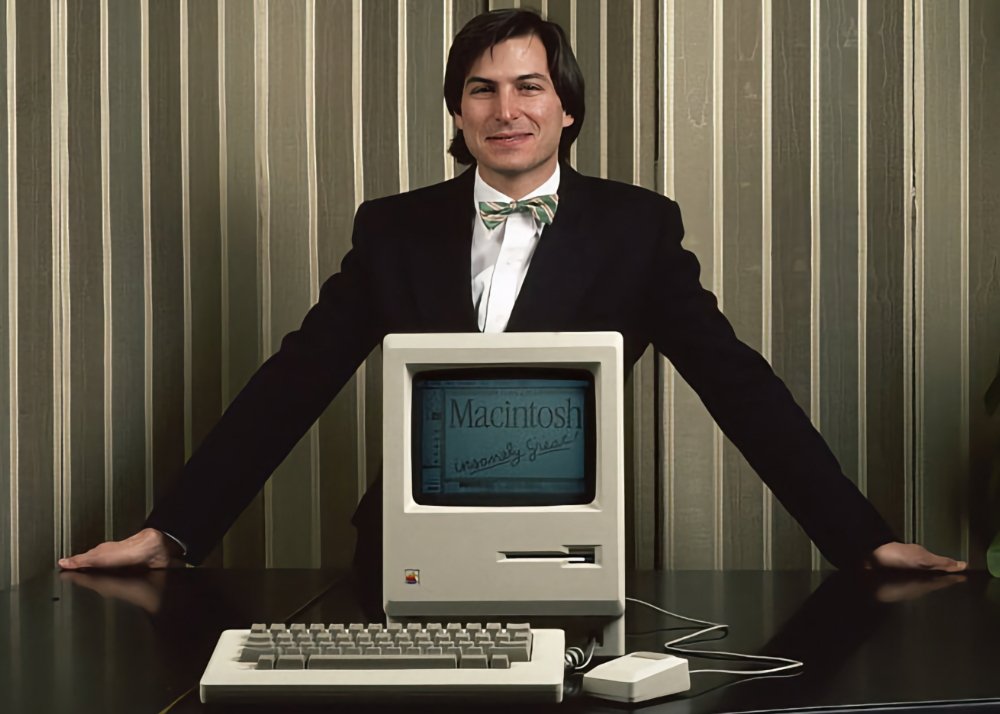
Steve Jobs presenting the original Mac - image credit: Steve Jobs Archive
Once again, Tim Cook would be stepping in as acting CEO. Jobs positioned the announcement as an attempt to avoid distractions for the company and "allow everyone at Apple to focus on delivering extraordinary products."
It didn't work, especially not with Apple's board of directors. They weren't pleased at Jobs hiding his health issues, not from the public — and from them.
Much later, Jerome York, then a board member, told the Wall Street Journal at the time that he was "disgusted" that Jobs hadn't been more honest about the health disclosures. He said that he had even considered resigning from the board over it.
For unknown reasons, though, the Journal did not report this until after York died the next year.
In April 2009, Jobs underwent a liver transplant, although this fact also wasn't disclosed until much later. Nor was the fact that Cook had offered to donate part of his own liver to help Jobs, an offer that was refused.
Steve Jobs did not appear at the WWDC in June 2009, but he did return to work at Apple as scheduled, later that month.
He then appeared on stage, for the first time in nearly a year, in September, at an event to introduce a new line of iPods.
"I'd like to thank everyone in the Apple community for the heartfelt support I got," he said. "It really meant a lot. And I'd also like to especially thank Tim Cook and the entire executive team at Apple. They really rose to the occasion and ran the company very ably in that difficult period."
Following that, the year 2010 was associated more with the launch of the first iPad and the iPhone 4. There was very little news about Jobs' health, but, again, the issue never quite went away.
The Last Leave
On January 17, 2011, Jobs announced that he would once again be taking a medical leave of absence.
"At my request, the board of directors has granted me a medical leave of absence so I can focus on my health," Jobs wrote in a letter. "I will continue as CEO and be involved in major strategic decisions for the company."
He once again placed Cook in charge in his stead, but unlike his 2009 leave, he did not announce a planned return date.
"I love Apple so much and hope to be back as soon as I can," Jobs added. "In the meantime, my family and I would deeply appreciate respect for our privacy."
Jobs would make his last public appearance not at an Apple Event, but rather a Cupertino City Council meeting on June 7, discussing the plans for Apple's new headquarters.
The final day
"I have always said if there ever came a day when I could no longer meet my duties and expectations as Apple's CEO, I would be the first to let you know." read Jobs' letter, on August 24, 2011. Unfortunately, that day has come."
He went on to "strongly recommend" that the board implement its succession plan, with Cook ascending to the CEO chair. On that same day, Tim Cook was formally appointed CEO.
"I believe Apple's brightest and most innovative days are ahead of it. And I look forward to watching and contributing to its success in a new role," Jobs said. "I have made some of the best friends of my life at Apple, and I thank you all for the many years of being able to work alongside you."
Jobs, despite his leave, reportedly worked an entire day at Apple's headquarters and attended a board meeting on the day of his resignation.
Steve Jobs died on October 5, 2011. He was 56 years old.
Lessons from a health crisis
Following Jobs' death, and especially after the publication of Walter Isaacson's authorized biography and some other books in the ensuing years, a few things became clear. Jobs, for the last five years of his life, was much more ill than he had let on.
According to the Isaacson book, Apple's board, whether to protect Jobs or its own stock price, either never pushed Jobs to go public about the severity of his condition, or actively covered it up.

Walter Isaacson's biography of Steve Jobs has been heavily criticized, but Jobs spoke exclusively and extensively for it while he was ill - image credit: Simon & Schuster/
The Isaacson book also revealed more about the timeline of the late CEO's illness. It painted a more complete picture of Jobs' refusal to use traditional medical treatment when he was first diagnosed, and how his family and friends, including Intel's Andy Grove, ultimately talked him into surgery.
Jobs admitted to the biographer that he had regrets about his original course of alternative treatment. To this day, it's still not clearly established exactly when Jobs' cancer recurred, or if it was ever in remission at all.
Steve Jobs accomplished a lot while fighting cancer, likely in immense physical pain a great deal of the time. And, he was right about Apple's brightest days being ahead of it, because he set the company up for success.
Rather than having any collapse after his death, the company has of course thrived, becoming worth $5 trillion. And in his time as CEO, Cook more than lived up to Jobs' desire that Apple's most innovative days" were to come.
The obvious choice
"The last two weeks for me have been the saddest of my life by far," said Tim Cook at Apple's memorial service for Steve Jobs in October 2011.
As Jobs had said in his resignation letter, Cook did take over permanently. While he now seems the clear choice, however, it truly wasn't so certain at the time.
Three years before Jobs's death, Fortune magazine quoted Cook addressing the idea that he could take over Apple.
"Come on, replace Steve? No. He's irreplaceable," Cook had said then. "That's something people have to get over. I see Steve there with gray hair in his 70s, long after I'm retired."
Then, too, there was Jony Ive. Whether he might want to become CEO or not, Ive had immense authority at Apple — - because Steve Jobs arranged it.
"[Jony Ive] has more operational power than anyone else at Apple except me," Steve Jobs had said according to Isaacson. "There's no one who can tell him what to do, or to butt out. That's the way I set it up."
He apparently set up other things, though, but in typical Apple fashion this was kept secret. Any large corporation will always have worked out who can replace key figures when necessary, and Apple was no exception.
But unlike most firms, Apple refused to even reveal that there was a succession plan until it was time to enact it.
However, Apple's habit of secrecy does not always help as much as it seems to think. Just as Steve Jobs's health concerns had raised questions among shareholders, so had Apple's apparent lack of a succession plan. There was even a demand from groups including the Central Laborer's Pension Fund that Apple make a plan and publish it.
Bloomberg's Eric Jackson argued, though, that there was no evidence to say Apple hadn't made its plans. The financial magazine even suggested that "Steve Jobs's hottest app may be [his] succession plan". (Article requires subscription.)
The plan wasn't confirmed at all until that resignation letter mentioned its recommendation that Cook become CEO. We still don't know what else was in the plan — but there were changes coming that may have been part of it.
However, there were also pressures from outside the company, pressures from people who did not believe Tim Cook could take over from Jobs. Apple's stock price and value took a dip around this time, too, though that is arguably because the company wasn't releasing major new projects.
Then it did — and unfortunately not very well. When Apple Maps was released with significant problems in 2012, Cook apologized publicly. "We are extremely sorry for the frustration and we are doing everything we can to make Maps better," he said in a public email that has since been removed from Apple's site.
Perhaps one of the things Apple did to make Maps better was to drop the man who introduced it. Scott Forstall left Apple a few weeks later on October 29, 2012.
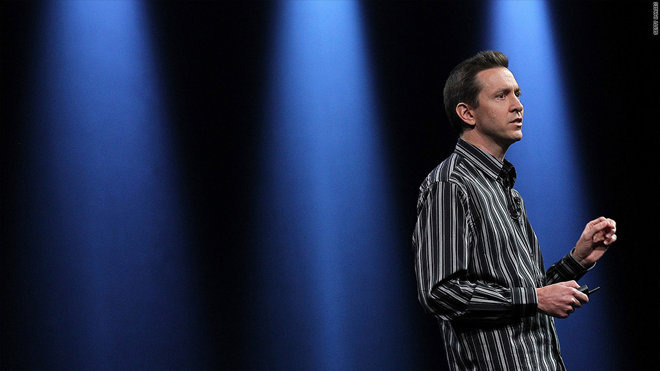
Scott Forstall on stage at an Apple event
Forstall had been a long-standing Apple employee and at times had been predicted to become CEO one day.
His departure was such big news that it rather overshadowed another one that was announced at the same time. John Browett, head of Apple retail, was out just a couple of months after Cook had originally hired him.
Browett had been a replacement for Ron Johnson, who had previously overseen the launch and huge growth of Apple Stores, but who had then moved to JC Penney — which remains in trouble to this day, along with a large portion of American retail other than Apple Stores.
After deciding Browett wasn't the right replacement, Cook took added the head of retail duties to his own workload.
Cook retained operational control of Apple's retail arm until he hired Angela Ahrendts away from fashion firm Burberry in 2014. With Apple's fortune and now assured success, it was probably an easier task to persuade Ahrendts to join Apple than it had been for Jobs to convince Cook.
He also radically changed Apple's management team. Eddy Cue, Craig Federighi, Jony Ive and Bob Mansfield were all Apple stalwarts who took on extra or new responsibilities.
Each of their roles has evolved since — and Ahrendts was replaced by Deirdre O'Brien in 2019, while Jony Ive left in the same year.
But for many years, this was the main Apple team. This was the team we would come to regularly see presenting at WWDC and Special Event events.
Culture
Those events changed radically because of the impact of COVID. With the move away from in-person events to exceptionally well-produced video presentations, Apple greatly expanded its pool of presenters.

Tim Cook (left) with Steve Jobs - image credit ZDNET
It's also diversified the very nature of its entire business. In terms of specific technology products, Apple has pressed ahead, and Cook has overseen, devices such as the Apple Watch, AirPods, HomePod and most recently the Apple Vision Pro.
At the same time, however, it has also introduced Apple TV+, Apple Card, and Apple Pay. Apple has gone from the technology company Jobs knew, to one that is at least as led by services as it is devices.
Cook has also changed the role of Apple's CEO, or at least he has worked to be a different CEO than Jobs. A reportedly highly private man, he nonetheless chose in 2014 to publicly come out as gay.
"If hearing that the CEO of Apple is gay can help someone struggling to come terms with who he or she is, or bring comfort to anyone who feels alone, or inspire people to insist on their equality, then it's worth the trade-off with my own privacy," Cook wrote in Bloomberg.
Cook also said that he plans to give away all of this wealth, once he's paid for the college education of his nephew, and he has been steadily doing exactly that.
In August 2018, for instance, he donated approximately $5 million worth of Apple shares to an undisclosed charity. He really did not seem to be like a typical CEO in this sense, since in 2023 he asked for his salary to be cut by 40%.
Long before then, though, there were already questions about when Tim Cook would leave Apple. It's a mark of how successful he was that the questions were as much about how Apple could cope with a new CEO.
And it's perhaps a mark of how some things never change at Apple, because the company kept everyone guessing over its CEO succession plan. Cook himself may have chosen to drop a hint, or was just caught musing, back in 2021 when he told New York Times journalist Kara Swisher that he didn't expect to be running Apple in another ten years.
"Probably not," he said. "But I can tell you that I feel great right now and the date is not in sight. But ten more years is a long time — and probably not ten more years."
Swisher asked him about what he wanted to do after he leaves and back then, he said he didn't know. "I don't have a clue because I love this company so much, that it is hard to imagine my life without it," he said. "And so I don't think I will know that until after I'm not here. Because I think I will run so fast that I'll never really think about it until I'm not running anymore. Does that make any sense?"
That does, but his later denying the whole interview doesn't. In March 2026, he flat-out denied that he had said anything like that he would leave by 2031, ten years on from that interview.
"No, I didn't say that," Cook said. "I never said that, that's a rumor going around."
If Jobs is still known for how he'd clasp his hands together and announce that there was just "one more thing," Cook had certain recognizable habits too. One is just how he delivers the simple line "good morning" at events.
But another is that he has a favorite way of redirecting interview questions onto whatever he would prefer to say. Rather than do the politician's trick of simply ignoring the question, he reframes it with a variation on the words "how I see it is..."
"Well, here's the way I look at it," he said in that March 2026 interview. "I love what I do deeply. 28 years ago, I walked into Apple, and I've loved every day of it since."
Surely that was an exaggeration, but it was a justifiable one right then because he was speaking during his world tour celebrating Apple's 50th anniversary.
He said this all this on March 17, 2026, and concluded by saying he "can't imagine life without Apple." But 34 days later, on April 20, 2026, Tim Cook announced his resignation as CEO.
Tim Cook is being replaced from September 1, 2026, by John Ternus, although he will stay working for Apple as Executive Chairman.
This succession was only fractionally more open than the one that saw Cook replace Steve Jobs. But it was significantly better managed and the handover continues to appear to be going smoothly.
As might be assumed, Ternus appears to already be acting as the CEO and Cook is arguably taking a back seat. Cook is still the titular CEO until the end of August 31, 2026, though.
By then, and excluding the times he covered as acting CEO, Cook will have led Apple for 15 years and 1 week. The company has radically changed over that time in terms of the products and services it makes, as well as its success and sheer profitability.
But once his departure was announced, Cook wrote an email to all Apple staff, saying:
Fifteen years ago, my friend and mentor Steve Jobs asked me to step into the role of CEO. It was an emotional and challenging moment for all of us at Apple, and I hoped I'd be up for the awesome responsibility I was taking on.I knew then what I know now: that there are certain values embedded in Apple that are bigger than any of us; a belief in the simple, not the complex; a determination to innovate with a focus on those few things that are truly important to the world and meaningful to us; an impatience for anything less than excellence in every group in the company; a commitment to enriching the lives of those we have a privilege to touch with our work; and a resolve to do all that we can to leave the world better than we found it.Those were the values that made Apple what it was then, and I am proud to say that they are the ideals that animate each of us today.