September 4, 1997: The writing is on the wall for Apple’s Newton product line as the recently returned Steve Jobs effectively kills the Newton Inc. spinoff.
He tells executives at the recently created subsidiary company not to bother moving into their new offices. The flip-flop on the Newton spinoff by Apple’s new interim CEO takes employees by surprise.
It’s quite the turnaround for the Newton division. Only months earlier, Apple portrayed it as large (and successful) enough to become its own company.
Steve Jobs nixes Newton Inc. spinoff
When Steve Jobs returned to Cupertino in 1997 to rescue the struggling company, one of his top priorities was deciding what Apple should stop doing. The Newton stood out as one of the clearest examples of the sprawling, unfocused Apple that Jobs inherited. And he wasted little time undoing his predecessors’ planned Newton Inc. spinoff.
The move showed the ruthless focus that would define the second, and far more successful, act of Jobs’ career. He realized Apple couldn’t afford to chase every interesting technology. The company desperately needed to concentrate its limited resources on products that could “make a little dent in the universe.”
The Newton product line would survive for a few months, but Jobs’ decision to kill the spinoff provided an early sign that Apple’s comeback would be about subtraction as much as invention.
Newton MessagePad: A short history of Apple’s PDA
Apple launched the Newton MessagePad in 1993 during Jobs’ years outside the company after he lost a boardroom battle with Apple CEO John Sculley. A device ahead of its time, the Newton offered handwriting recognition and AI technology in a mobile form factor. Keep in mind that at this time, even regular laptops remained relatively uncommon.
Unfortunately, early versions of the Newton failed to deliver the kind of results Apple hoped for — tarnishing the company’s brand in the process.
By the mid-1990s, though, Apple fixed many of the product line’s early problems. Devices like the Newton MessagePad 120 ran on the superior NewtonOS 2.0, an operating system upgrade that fixed many of the handwriting-recognition problems that plagued earlier models.
Newton Inc. spinoff
March 1997’s MessagePad 2000 was the best Newton yet, and became a commercial and critical success. In its wake, Apple laid out plans to make the Newton division its own company. Sandy Benett, former vice president of the Newton Systems Group, would lead it.
On August 6, Benett said Newton Inc. was “completely autonomous from Apple.” With its own board of directors and corporate logo, all it needed to take the final step was to find a CEO and move to new offices in Santa Clara, California.
The remit of this new company was to sell the MessagePad 2000 and develop new technologies for the device line. Many hoped the spinoff would attract funding and go public within a few years. Coming during the pre-2000 tech bubble, a big Newton IPO sounded like a massive positive — especially separated from the still-unprofitable Apple.
Trying to peddle the MessagePad
That picture wasn’t exactly accurate, unfortunately. While the Newton seemed poised to cease losing money for Apple, nobody viewed the personal digital assistant as a long-term prospect. Former Apple CEO Gil Amelio tried to sell off the technology cheaply to everyone from Samsung to Sony during his tenure leading the company.
When everyone declined, Apple decided to spin off the Newton division as a separate business. Some 130 Apple employees made the transition to the new company.
Then Apple made a U-turn. The plot to make Newton its own startup was hatched under Amelio, and new interim CEO Steve Jobs didn’t agree with it. With no personal attachment to the brand, the Apple co-founder saw no reason to expend staff on supporting a product that sold only 150,000 to 300,000 units during its four and a half years on shelves.
Steve Jobs kills Newton Inc. spinoff to focus on eMate 300
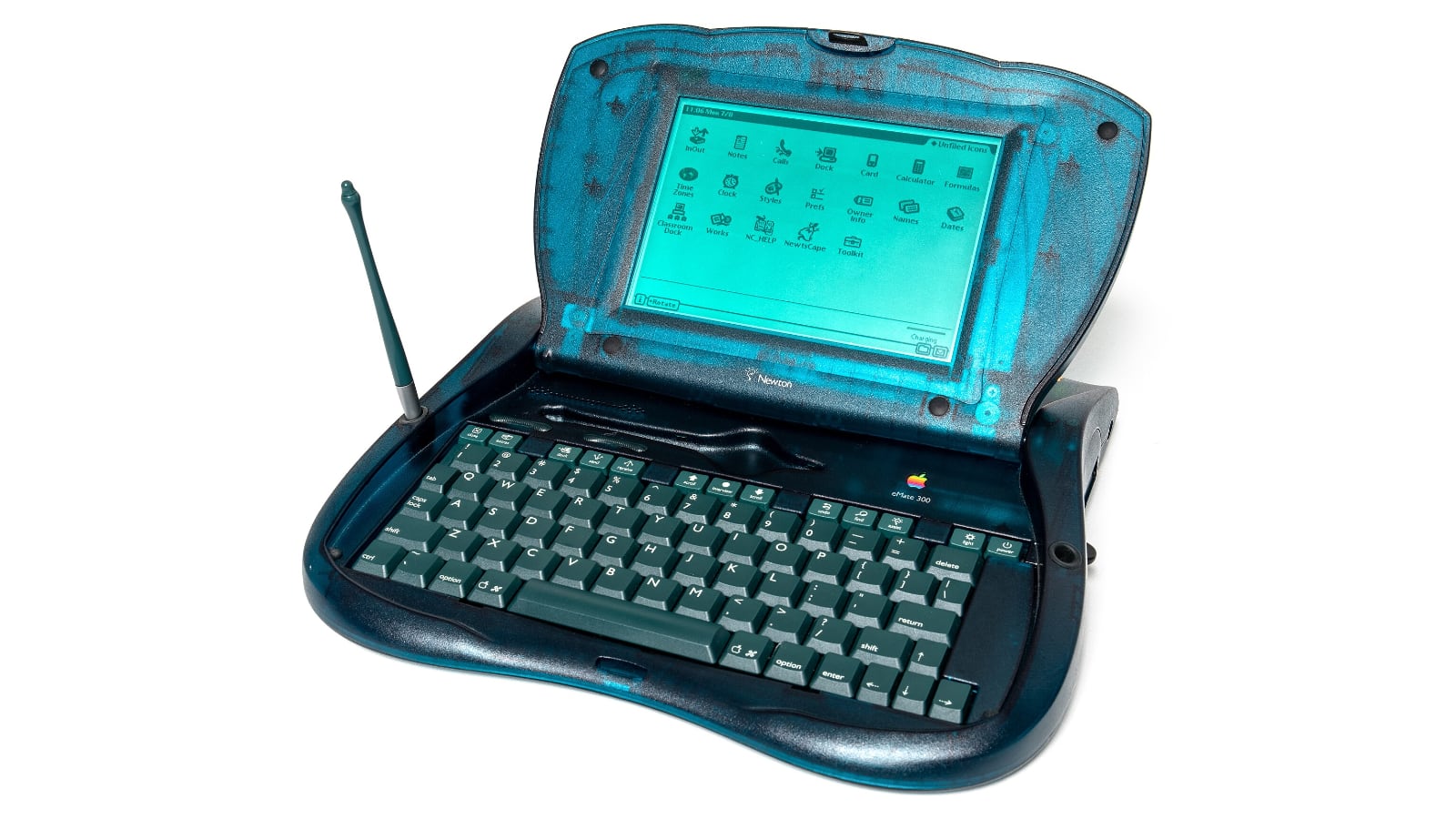
Photo: Felix Winkelnkemper/Wikimedia Commons CC
Jobs was, however, interested in the eMate 300, another of the products to come out of the Newton line. This $800 PDA featured a built-in keyboard and a colorful, curvaceous clamshell design that prefigured Apple designer Jony Ive‘s boldy colorful iMac and iBook. Aimed initially at the education market, the eMate 300 was one of the most unique-looking Apple products of its day.
Five days after telling the Newton execs not to bother moving into their new offices, Jobs said Apple would pull the product line back under its banner and focus efforts on building up the eMate 300. At the time, Jobs said Apple was absolutely not “dumping the MessagePad.”
However, early the following year, he abandoned the Newton MessagePad so Apple could focus on the Macintosh.
Do you remember the Newton MessagePad? Leave your comments below.