 June 7, 1993: Apple debuts the PowerBook 180c, a solid upgrade that brings a world of dazzling colors to the company’s laptop line.
The 180c’s big improvement over the grayscale PowerBook 180, which launched the previous October, is its active-matrix, 256-color screen. Such a screen is something of a novelty for laptops in the early 1990s.
PowerBook 180c: A great portable Mac
With the PowerBook 180c, Apple didn’t invent the color laptop — but it perfected it. At the time, portable computing was a world of washed-out passive-matrix displays and painful tradeoffs.
The 180c changed that equation with a sharp, active-matrix screen capable of displaying 256 colors at a then-impressive 640×480 resolution, making it the first laptop whose color display felt like an upgrade rather than a compromise. It also showed Apple’s willingness to push notebook technology forward at the expense of battery life — a familiar balancing act that still shapes MacBook design decades later.
A successful laptop lineup
The PowerBook 180c was one of the high-end models in Apple’s enormously successful PowerBook 100 series. Launched in late 1991, the PowerBook quickly became a staple of Apple’s product line — and a well-deserved commercial and critical smash.
The PowerBook 180c wasn’t the first color PowerBook. It was beaten to that title by the PowerBook 165c, which came with an 8.4-inch, passive-matrix color display that could appear dim if not viewed head-on under ideal conditions.
However, the PowerBook 180c was the first to offer high-quality color. Its backlit, active-matrix display looked great from whichever angle you looked at it.
In short, this was the first great color display on a Mac laptop. The 180c also featured a slightly higher resolution than the PowerBook 165c, being the first PowerBook to natively run at 640×480 pixels, rather than the 165c’s 640×400.
PowerBook 180c specs
The PowerBook 180c also boasted impressive specs. It came with a zippy 33 MHz Motorola 68030 CPU and a Motorola 6882 math coprocessor. It packed 4MB of RAM (expandable to 14MB using an additional RAM card). Despite its chunky case design, the laptop proved comfortable to use.
The laptop also featured a bunch of ports. You got a plug for Apple Desktop Bus services, two RS-422 serial ports, a SCSI port, a microphone and speaker jacks — even a bay for a modem. In addition, users could output to external monitors using a 256-color video connector.
For all these reasons and more, the PowerBook 180c remained in great demand for its entire lifespan.
However, there were a couple of downsides
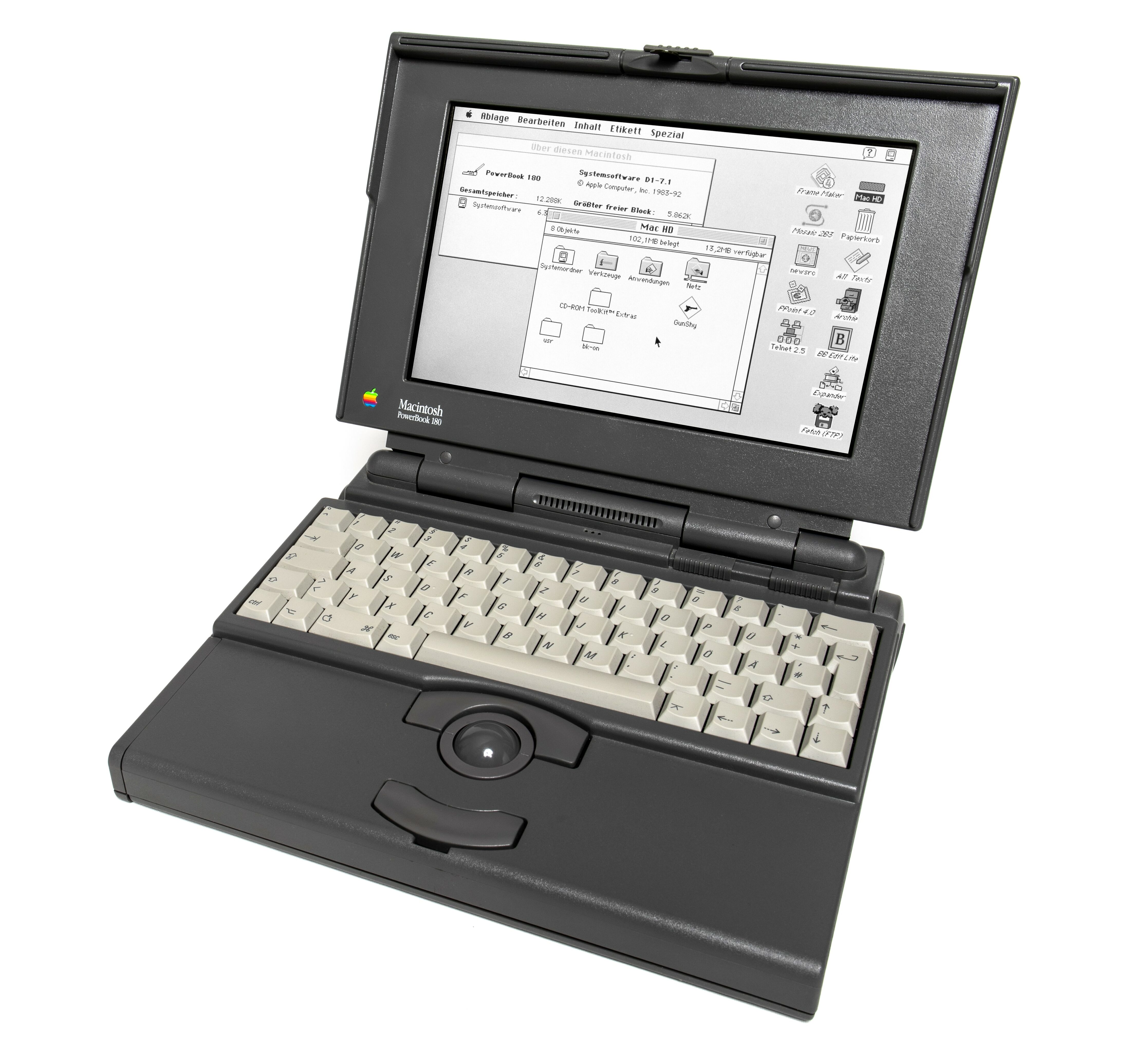
Unfortunately, the PowerBook 180c suffered from two downsides. First, the display was slightly smaller than the 10-inch display of the original PowerBook 180 — and actually a fraction smaller than the 9-inch PowerBook 165c. Most users agreed that the smaller size was a fair tradeoff for high-quality color, but it still meant the computer’s display wasn’t superior to its predecessor in every single way.
The bigger problem? Pathetic battery life. Running both a 33 MHz CPU and color graphics limited how long you could use the laptop on a single charge. According to Apple’s own figures, it lasted between one and two hours — but reasonably intense usage could cut that down to less than an hour.
The PowerBook 180c cost $3,719 for the basic model, while the fully kitted-out version cost $4,079. That’s between $8,570 and $9,400 in today’s money. Apple ultimately discontinued the laptop in March 1994.
Did you use this PowerBook model? Leave your comments below.