October 24, 1988: Three years after leaving Apple, Steve Jobs prepares to launch the NeXT Computer, a machine he hopes will cement his reputation as a tech genius and blow away the machines produced by Cupertino.
The new NeXT Computer receives a wave of positive publicity. Fawning stories show exactly what the 33-year-old Jobs has been working on — and what’s coming next.
NeXT: The computer the world was waiting for
Before Steve Jobs became the legendary comeback king of Apple, he had to prove he was more than the guy who got kicked out. The NeXT Computer was his high-stakes attempt to show the world he could build another revolutionary machine without Apple’s resources or his old collaborators.
As the press eagerly anticipated the NeXT Computer’s arrival in 1988, Jobs was selling more than a sleek, futuristic computer. He was trying to rebuild his reputation as a visionary who could turn audacious ideas into products people actually wanted. While NeXT ultimately struggled to sell hardware, its software would become the foundation of modern macOS and iOS after Apple bought the company and brought Jobs back.
In short, the machine that failed to conquer the computer world set the stage for one of tech’s greatest second acts.
Mainstream media is all over Steve Jobs’ comeback
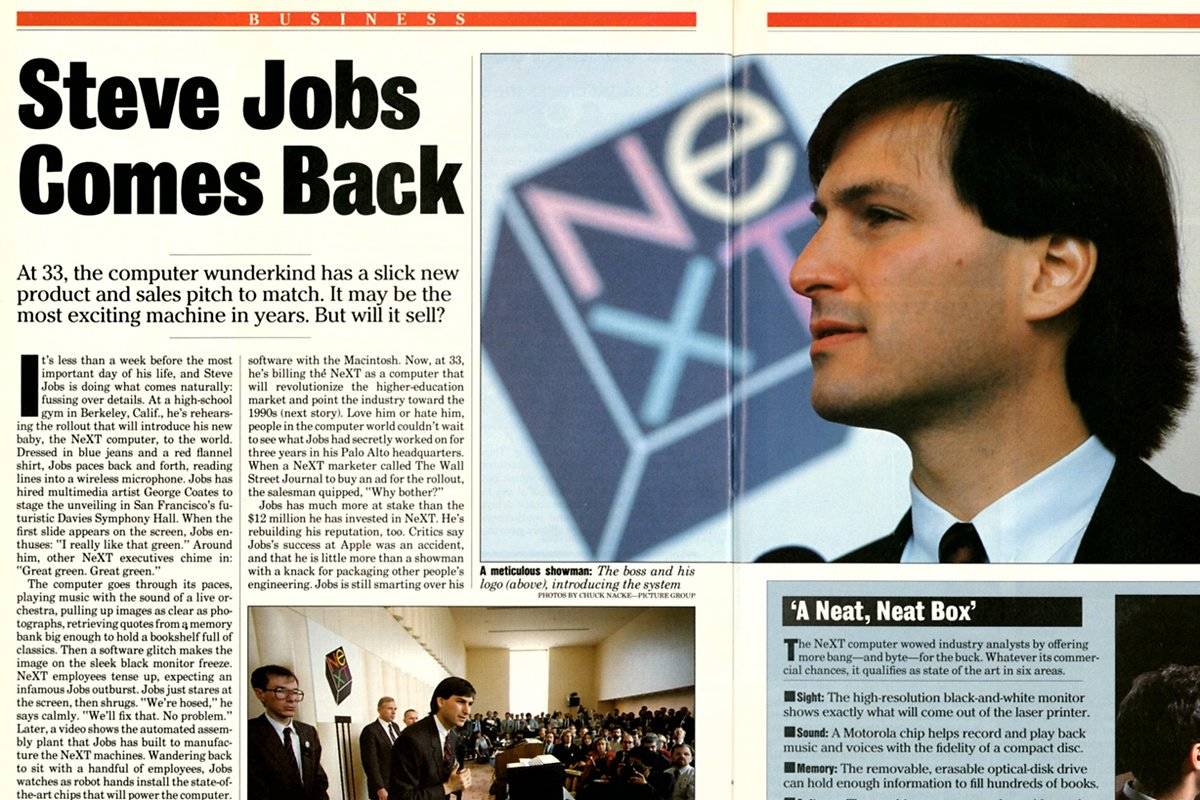
Image: Newsweek
A pair of articles in high-profile news magazines (remember those?) illustrated the massive interest in Jobs’ next endeavor. Time and Newsweek published twin articles on the same day, both lavishing Jobs’ new computer with rapturous admiration. The two articles in question were entitled “Soul of the Next Machine” (named after Tracy Kidder’s excellent book The Soul of a New Machine) and, simply, “Steve Jobs Comes Back” (see above).
Looking back on the stories now is to revisit an unusual point in Jobs’ career. He seems a long way from the austere, respected digital emperor he became during the last decade of his life.
At NeXT, Jobs was about to put up or shut up. His new machine would demonstrate whether he could launch a third world-changing computer (after the Apple II and the Macintosh). This time, he would need to do it without Apple co-founder Steve Wozniak or the graphical user interface pioneers of Xerox PARC.
Furthermore, unlike Apple — which started in the most low-fi, DIY way imaginable — NeXT was a money pit into which Jobs was throwing his own fortune. The NeXT logo alone cost him $100,000. And other stories from the time paint a picture of a still-immature, perfectionist visionary refusing to settle for anything but the best.
Newsweek laid out the high stakes in its article, published on this day in 1988.
“Jobs has much more at stake than the $12 million he has invested in NeXT,” wrote John Schwartz. “He’s rebuilding his reputation, too. Critics say Jobs’s success at Apple was an accident, and that he is little more than a showman with a knack for packaging other people’s engineering. Jobs is still smarting over his 1985 showdown with John Sculley, the CEO he recruited to Apple — and who ousted him in a power struggle. The public has tended to view Jobs as a techno-punk, immensely talented and charming but a tad arrogant. Learning from his defeat and re-emerging with a mature new style and machine would show the world that Steve Jobs is a serious computer maker, can run a company — and has finally grown up.”
Steve Jobs: ‘Techno-punk’?
Even if Jobs was a “techno-punk,” by 1988, many people had embraced the tech lifestyle. Just a decade earlier, when the Apple II launched, mainstream publications covered personal computers with bemusement. In the late 1970s, many smart journalists talked about storing recipes as a “killer app” for personal computers.
By the time the NeXT Computer was about to launch, however, Time writer Philip Elmer-Dewitt opened his article with an entirely different perspective.
“To be a hit with humans, a computer needs to be more than the sum of its hardware and software and metal skin,” he wrote. “The most successful machines have a built-in emotional component, something that connects the tools in the computer with the whims of its user. Perhaps no one understands this better than Steven Jobs, co-founder of Apple Computer and the man who made the personal computer a household term.”
Reading the articles about NeXT’s upcoming launch will give you a definite sense of societal change.
Paying homage to NeXT Computer

Image: NeXT
Today’s installment of “Today in Apple history” shows two things. It takes us back to a time before Steve Jobs was, well, Steve Jobs. It also shows how the world bought into what Jobs was preparing to do at NeXT. This formed much of the template for the rapturous responses that Jobs’ subsequent world-changing devices received.
Do you remember the NeXT Computer? Do you own one? Leave your comments below.