How the Internet Crosses Oceans Without You Noticing
A closer look at how undersea cables connect the world.
How the Internet Crosses Oceans Without You Noticing
Undersea cables carry around 99 percent of international data.
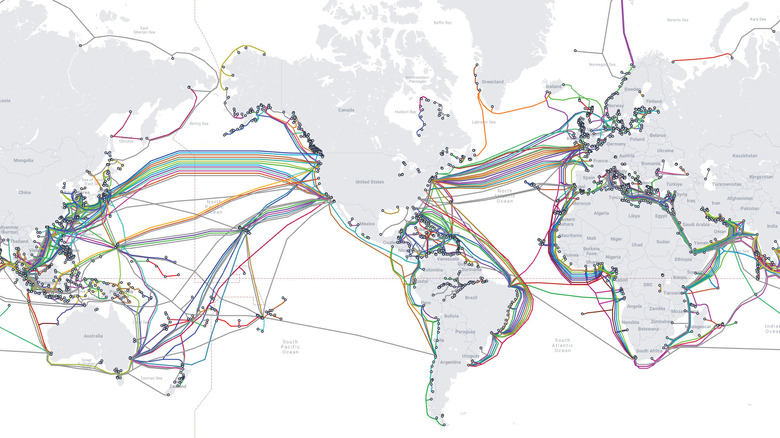
The ocean floor is home to some of the strangest creatures on Earth. But it's also where your strangest TikToks go to reach Alaska, Hawaii or the other side of the planet. Most of the world's international online traffic travels through cables lying at the bottom of the ocean.
Earlier this year, TAT-8 (Trans-Atlantic Telephone 8), the very first transatlantic fiber-optic cable, was pulled up after 38 years. It had been sitting, unused, at the bottom of the Atlantic for nearly a quarter of a century. It might be mind-boggling to think about how long these sit in the depths of our oceans, transmitting our emails, video calls and memes across the globe. Let's make sense of how these cables work and why pulling the TAT-8 up was worthwhile.
About 99 percent of international internet traffic uses these undersea cables. There are over 500 of them in service worldwide. Laid end to end, they would stretch for over a million miles, wrapping around the Earth multiple times.
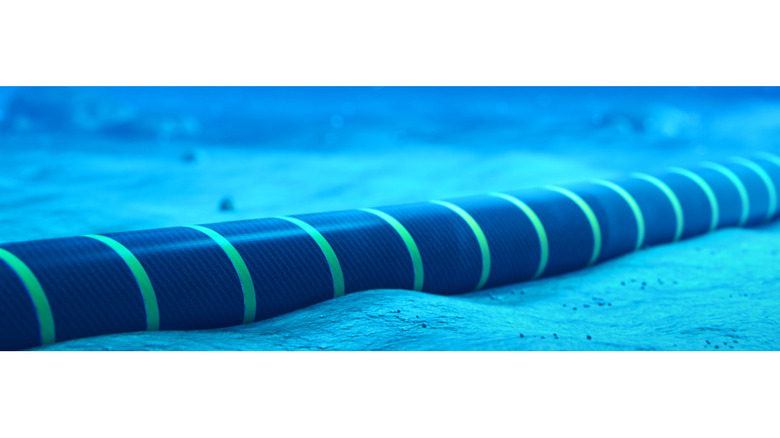
Each cable is roughly as thick as a garden hose. Inside are strands of glass fiber no thicker than a human hair. Lasers send coded pulses of light through these fibers billions of times per second. (Meanwhile, signal boosters along the cable amplify the lasers as they travel.) Dozens of different laser colors can travel through the same fiber at once, each carrying its own stream of data. One might include an email traveling from Boston to Melbourne, while another could transmit a video call from New York to Tokyo. Each cable can move hundreds of terabits of data per second.
A months-long journey to get the internet moving
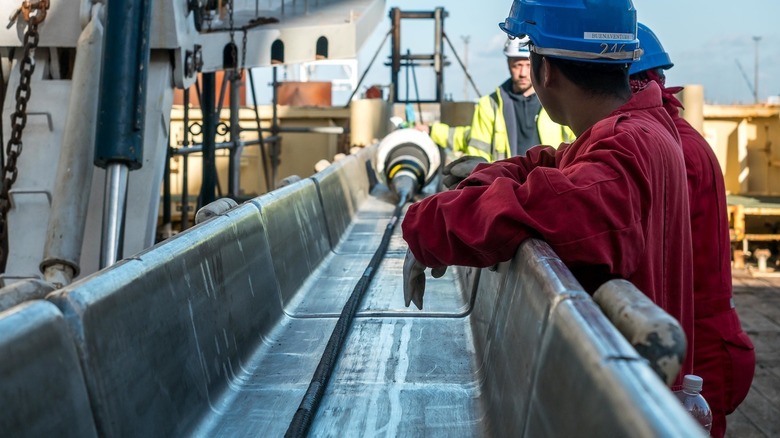
Getting these cables down there is a lengthy ordeal. First, engineers have to chart an efficient route that avoids underwater obstacles. Then, once the cable is manufactured, workers move it onto a ship, where they spool it into enormous tanks. This process alone can take about a month.
Once the ship departs, it moves at a breathtaking speed of... 6 miles per hour. (That's roughly the equivalent of a light jog.) Crews can be at sea for months, slowly pulling cable from these huge tanks, routing them out through openings on the ship's stern. If they run into rough weather, workers might have to cut the line, attach its end to a buoy, and go elsewhere to wait it out. After conditions improve, they retrieve the cable, splice it and resume their plodding journey across the sea.
Finally, when it reaches the other side of the continent, the cable connects to a data center where it will distribute your email or cate meme to its receiver. Only there is it likely to go airborne, whether through mobile cell towers or local Wi-Fi networks. (Despite the growth of Starlink and similar services, satellite internet only makes up a tiny percentage of all internet traffic.)
Replacing and recycling the cables
The cables can withstand a lot, but the UN says there are about 150 to 200 "cable incidents" per year. Most areas include redundant lines to ensure that if one cable goes down, others can pick up the slack. But some remote regions might lose all internet access for weeks if a single cable fails. In 2022, the South Pacific island nation of Tonga lost its internet and telephone communications for over a month after a volcano eruption damaged the lone cable connecting it to the rest of the world.
Although outages like that can be caused by natural disasters, about 80 percent stem from human activity — usually ship anchors or fishing trawlers. In recent years, we've even seen a few incidents of sabotage.
When the cables break, the physical work of fixing them isn't always the hardest part. "What's often more complex is securing all the required permits and licenses, especially when multiple or overlapping jurisdictions are involved," Tomas Lamanauskas, Deputy Secretary-General of the International Telecommunication Union (ITU), told UN News.
Other times, cables just age out. Each one has an average lifespan of about 25 years.
As I mentioned earlier, though the TAT-8 had been pulled up just this year, it had actually been out of service since 2002, when it developed a fault that would have been prohibitively expensive to fix. So, it sat, unused, at the bottom of the Atlantic for nearly a quarter century. Although recycling it had environmental advantages, there were more pressing motives for its recovery: freeing up the location for new cables and retrieving its valuable copper.
Originally published on Engadget